How Parents Can Guide Reading Without Becoming Teachers
Want to help your child read without the nightly homework battles? Learn how to guide their literacy journey without acting like a teacher.
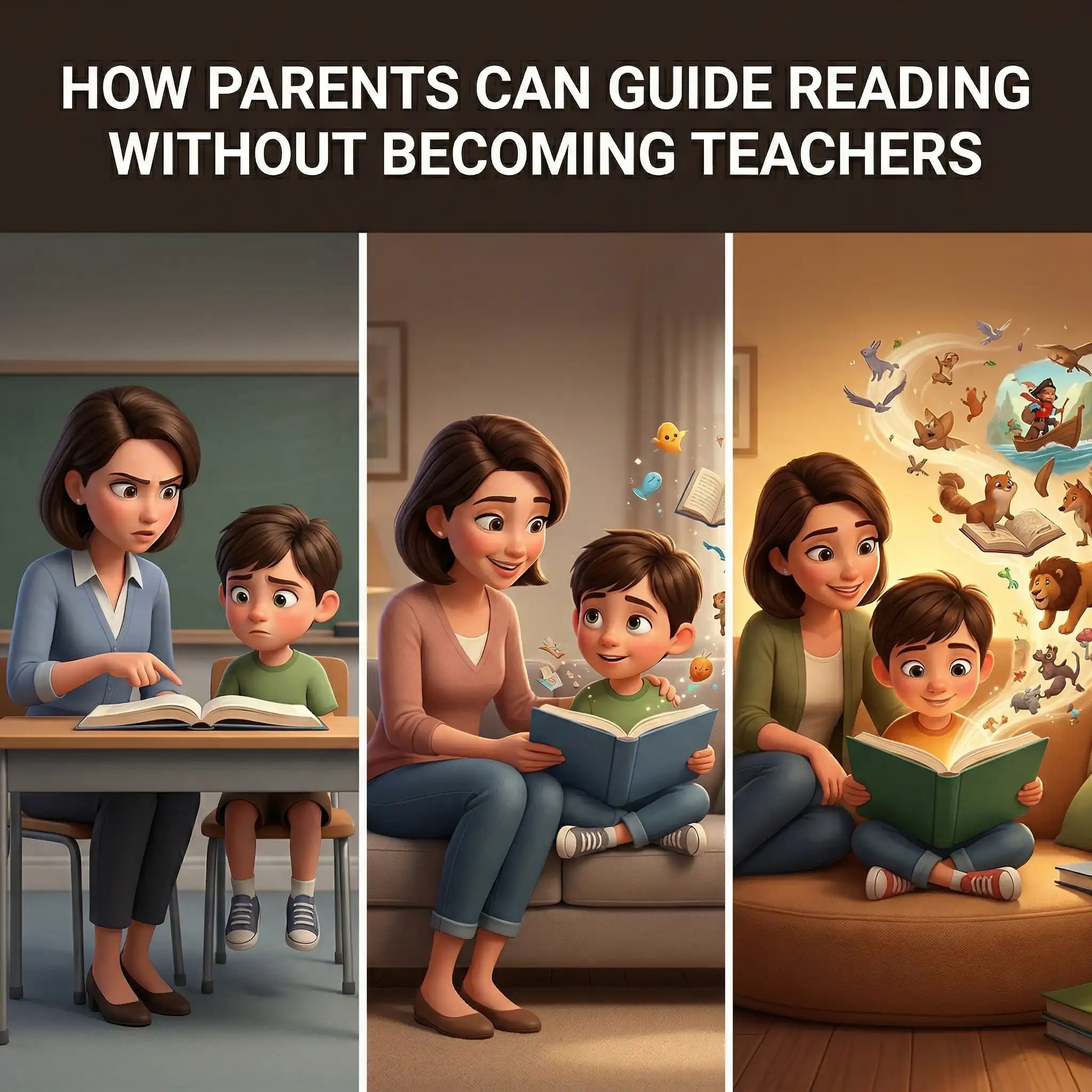
How Parents Can Guide Reading Without Becoming Teachers
When your child was a toddler, reading was pure magic. You would snuggle up, put on funny voices, and share a story. You were their favorite storyteller.
But somewhere around the first grade, the dynamic shifts. The school starts sending home reading logs and leveled books. Suddenly, you are sitting across from them at the kitchen table, correcting their pronunciation, tapping the page, and asking, "Are you sure that word is 'through'?"
Before you know it, you have transformed from a comforting parent into a strict teacher. And your child has transformed from an eager listener into a frustrated student who wants nothing to do with books.
It is a painful transition for everyone involved. But here is the good news: your child already has a teacher at school. They don’t need another one at home. What they need is a guide. Here is the science behind why shifting out of the "teacher" role is crucial, and how you can seamlessly guide their reading journey without the nightly power struggles.
The Science of "Instruction" vs. "Entertainment"
When we step into the teacher role, we naturally start evaluating. We correct mistakes, ask pop-quiz questions to test comprehension, and dictate what they should read. This well-meaning instruction actually kills the joy.
The Science: A landmark study published in the Journal of Educational Psychology (Baker, Scher, & Mackler, 1997) examined different styles of home literacy environments. The researchers found that when parents focused primarily on the instructional aspects of reading (correcting errors, focusing on skills), children had significantly lower motivation to read. However, when parents focused on reading as entertainment and a shared social experience, children developed high intrinsic motivation and naturally became better readers.
Your primary job at home isn't to build their decoding skills; it is to build their reading identity. Here is how to make the shift.
1. Shift from "Evaluator" to "Curious Co-Reader"
Teachers have to evaluate; parents get to explore. When your child finishes reading a page or a chapter, stop asking test questions like, "What was the main character's name?" or "Why did they go to the store?" * The Fix: Model genuine curiosity. Share your own raw, unfiltered reactions to the story, just like you would if you were watching a movie with a friend. Say, "Wow, I can't believe she said that to her sister. I would be so mad if someone said that to me. What do you think?" By treating them as an intellectual equal rather than a student, you invite them to think critically about the story without the fear of getting the answer "wrong."
2. Outsource the "Instruction" to a Mentor
For kids in the critical 6-to-12-year-old window, separating the roles of "parent" and "teacher" is incredibly difficult. Children in this age group are fiercely seeking independence, and any correction from a parent can feel like a personal critique.
The Fix: Bring in a neutral third party. One of the most effective, stress-free ways to guide your child's reading is through 1-on-1 literary mentorship. Pairing your child with a bright, enthusiastic college student—such as an undergraduate from a top engineering or liberal arts university—completely changes the dynamic.
A college mentor acts like a cool older buddy, not an authority figure. They can read aloud together, gently help with difficult vocabulary, and discuss the book in a relaxed, peer-to-peer setting. Because the mentor isn't their parent, the child doesn't feel the heavy weight of expectation. It turns reading practice into a highly anticipated social hangout.
3. Curate a "Premium" Reading Environment
Teachers control the curriculum; parents control the environment. If you want to guide your child toward books, you have to design an environment where reading is the most appealing option in the room.
The Fix: Think of the clean, minimalist, premium feel of brands like Apple or Duolingo—they draw you in because the experience is intuitive and beautiful. Apply that to your home. Instead of stuffing books tightly onto a dusty shelf, create a highly visual, accessible reading space. Leave a curated selection of beautiful graphic novels, visually engaging non-fiction, or their favorite chapter books face-up on the coffee table. Make the books easy to grab and the lighting cozy. When the environment is inviting, you won't have to force them to sit down.
4. Let Them Be the Expert (The "I Need Help" Strategy)
Nothing empowers a child more than feeling smarter than the adults in the room. When you constantly act as the teacher, your child is always the novice. Flip the script.
The Fix: If they are reading a book about dinosaurs, space, or a video game universe like Minecraft, pretend you are completely clueless. Ask them to explain it to you. "Wait, I don't get it—how does a creeper work?" or "Which one of these dinosaurs was the fastest?" Forcing them to summarize the text to teach you is one of the highest forms of reading comprehension practice, and they will happily do it because it feels like a game, not a quiz.
The Bottom Line
You don't need a teaching degree, a whiteboard, or a stack of phonics flashcards to raise a strong reader. We are parents, not principals.
By taking the pressure off, curating a beautiful reading environment, and occasionally bringing in a cool, older mentor to share the load, you allow your child to simply enjoy the magic of a good book. Let the teachers handle the mechanics of reading; you get to handle the joy.
Share this post! Are you tired of the nightly reading battles? You are not alone. Hit the share button to pass this article along to a fellow parent who could use permission to stop acting like a teacher today!
Responses
No responses yet. Be the first to share your thoughts.