How to Know If a Book Is Too Easy or Too Hard for Your Child
Learn simple ways to check if a book is the right level—so your child reads with flow, confidence, and enjoyment instead of frustration.
Let’s be honest for a second. Have you ever stood in the middle of a bookstore or library, staring at shelves packed with colorful spines, and felt a sudden wave of total overwhelm?
Or maybe you’ve watched your child pick up the exact same Dog Man graphic novel for the sixth time, and a quiet, nagging voice in your head whispered,
“Shouldn’t they be reading something harder by now? Are they falling behind?”
If you just nodded, take a deep breath. You are absolutely not alone.
As parents, we carry so much invisible anxiety about our kids' reading habits. Especially as they grow into that crucial 8-to-14-year-old window, the pressure ramps up. We see a friend’s child breezing through thick fantasy novels, and panic sets in. We think the solution is to hand our own child a harder book to push them.
But here is the truth, backed by years of cognitive psychology: Pushing a child into a book that’s too hard doesn't make them a better reader. It makes them hate reading.
So, how do we find that magical sweet spot? How do we find the books that challenge them just enough to grow, without crushing their confidence?
Let’s talk about the science of reading, minus the academic jargon, and look at the real-life signs your child is trying to show you.
The Psychology of the "Sweet Spot"
In developmental psychology, we talk a lot about something called the Zone of Proximal Development (ZPD).
Think of ZPD like a rubber band. If you don’t stretch it at all, it stays loose and useless. If you stretch it way too far, it snaps. But if you stretch it just right, it holds everything together perfectly.
When a child reads a book in their sweet spot, they are stretching their brain just enough to learn new words, but they still have enough mental energy left to actually enjoy the story. If we force them into the "snapping" zone, 100% of their brainpower goes into just sounding out the words. They have zero energy left to imagine the world, laugh at the jokes, or connect with the characters.
That is exactly how a child decides, “I’m just not a reader.” Here is how to read your child’s behavior so you can keep them in that perfect, growing stretch.
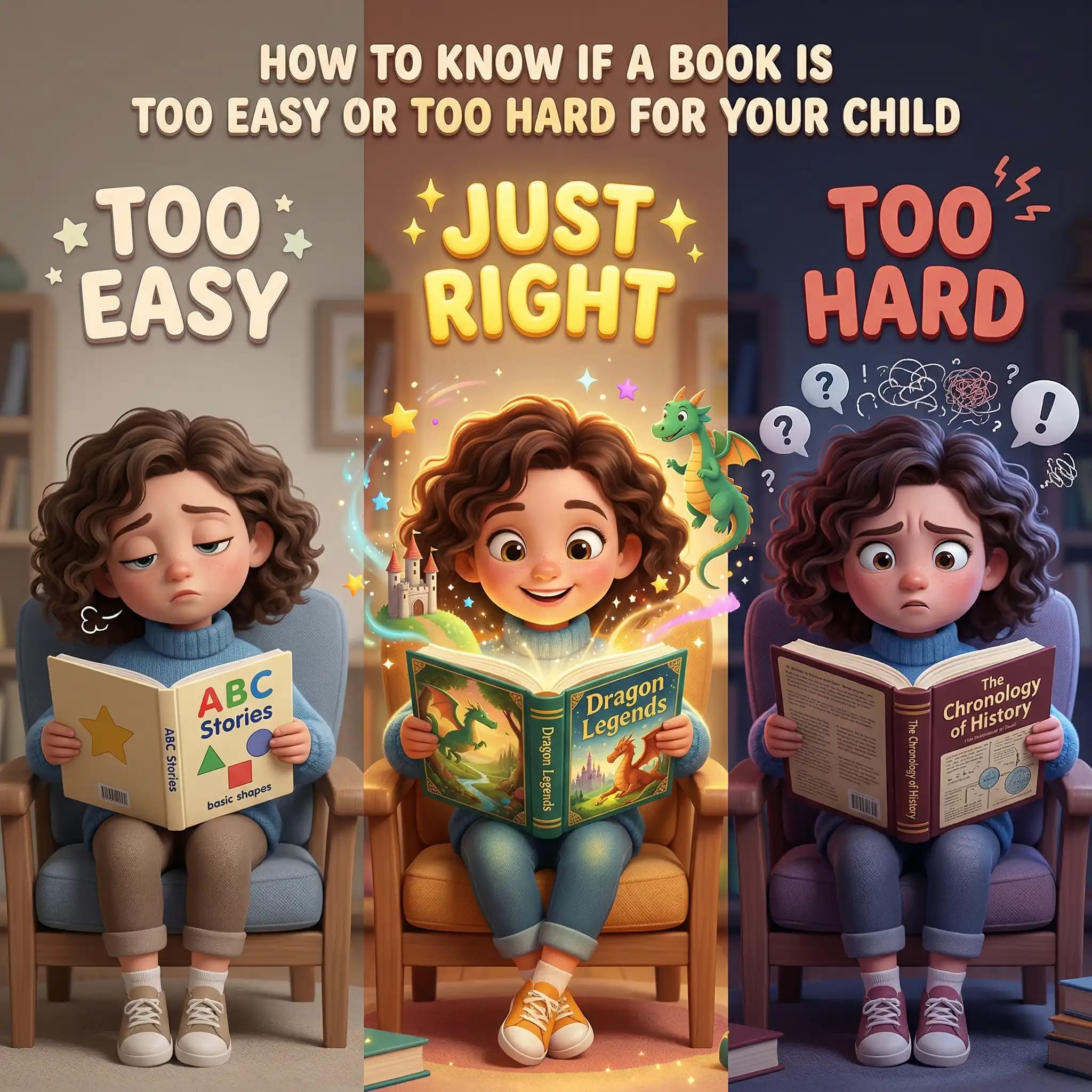
🚩 The Frustration Zone: Signs a Book is "Too Hard"
This breaks my heart to see, because kids rarely say, "Mom, this text is too complex for my current decoding skills." Instead, they act out. When a child misses more than 1 in 10 words on a page, reading feels like climbing a mountain in flip-flops.
Watch for these silent cries for help:
The "Robot" Voice: They read in a choppy, monotone voice. They aren't reading a story; they are just surviving one word at a time.
The Avoidance Dance: Suddenly, they need a glass of water. They need to use the bathroom. They drop their pencil. Anything to delay opening the book.
The Blank Stare: If you gently pause them at the end of a page and ask, "Oh wow, what just happened?" they look at you with total panic because they honestly have no idea.
What to do: Validate them! Say, "You know what? This book seems a little clunky right now. Let's read it together." You read a page, they read a sentence. Or, just let them listen to the audiobook while they follow along. You protect their confidence while still exposing them to the great vocabulary.
🟢 The Comfort Zone: Signs a Book is "Too Easy"
This is the one that causes the most parent guilt. We worry that easy books are "junk food" for the brain. But I need you to hear this: Easy reading is deeply, scientifically important. When a child can read 99% of the words on a page without pausing, they are in the Independent Level.
What it looks like:
They devour the pages.
They actually laugh out loud or gasp at the plot twists.
They want to tell you all about the characters.
What to do: Celebrate it! Let them binge-read those graphic novels and easy series. Reading "easy" books builds fluency, increases reading speed, and most importantly, it wires their brain to associate reading with joy, relaxation, and safety. A child who loves reading will eventually challenge themselves. A child who feels forced will quit.
⭐ The Growth Zone: Finding What's "Just Right"
This is where the magic happens. At this level, your child knows about 90% to 95% of the words. The story flows, but every few pages they hit a speedbump—a new word they have to figure out using context.
The Foolproof "Five-Finger Test" You don't need a reading assessment chart to figure this out. The next time your child picks up a book, have them open to a random page in the middle and read it out loud. Tell them to hold up one finger for every word they don't know.
0-1 Fingers: This is their Comfort Zone. Great for a lazy Sunday afternoon.
2-3 Fingers: Just Right. They will learn, grow, and still love the story.
4 Fingers: A bit tough. They’ll probably need you to sit with them and be their reading mentor.
5+ Fingers: Frustration Zone. Put it back on the shelf for a few months. It gives them something to look forward to!
The Takeaway for Parents
Your child's reading journey is not a race. It’s not about who gets to the highest reading level the fastest. It is about raising a human being who reaches for a book when they want to learn, when they want to escape, or when they want to feel understood.
Take the pressure off. Let them read the "easy" stuff. Guide them gently through the "just right" stuff. You are doing a wonderful job.
References for the Curious Parent:
Vygotsky, L. S. (1978). Mind in society: The development of higher psychological processes. Harvard University Press.
Hasbrouck, J., & Tindal, G. A. (2006). Oral reading fluency norms: A valuable assessment tool for reading teachers. The Reading Teacher.
Sweller, J. (1988). Cognitive load during problem solving: Effects on learning. Cognitive Science.