How to Replace Screen Time With Reading (That Kids Actually Enjoy)
Want to swap the iPad for a book without starting a war? Discover stress-free, science-backed ways to help your child actually enjoy reading over screens.
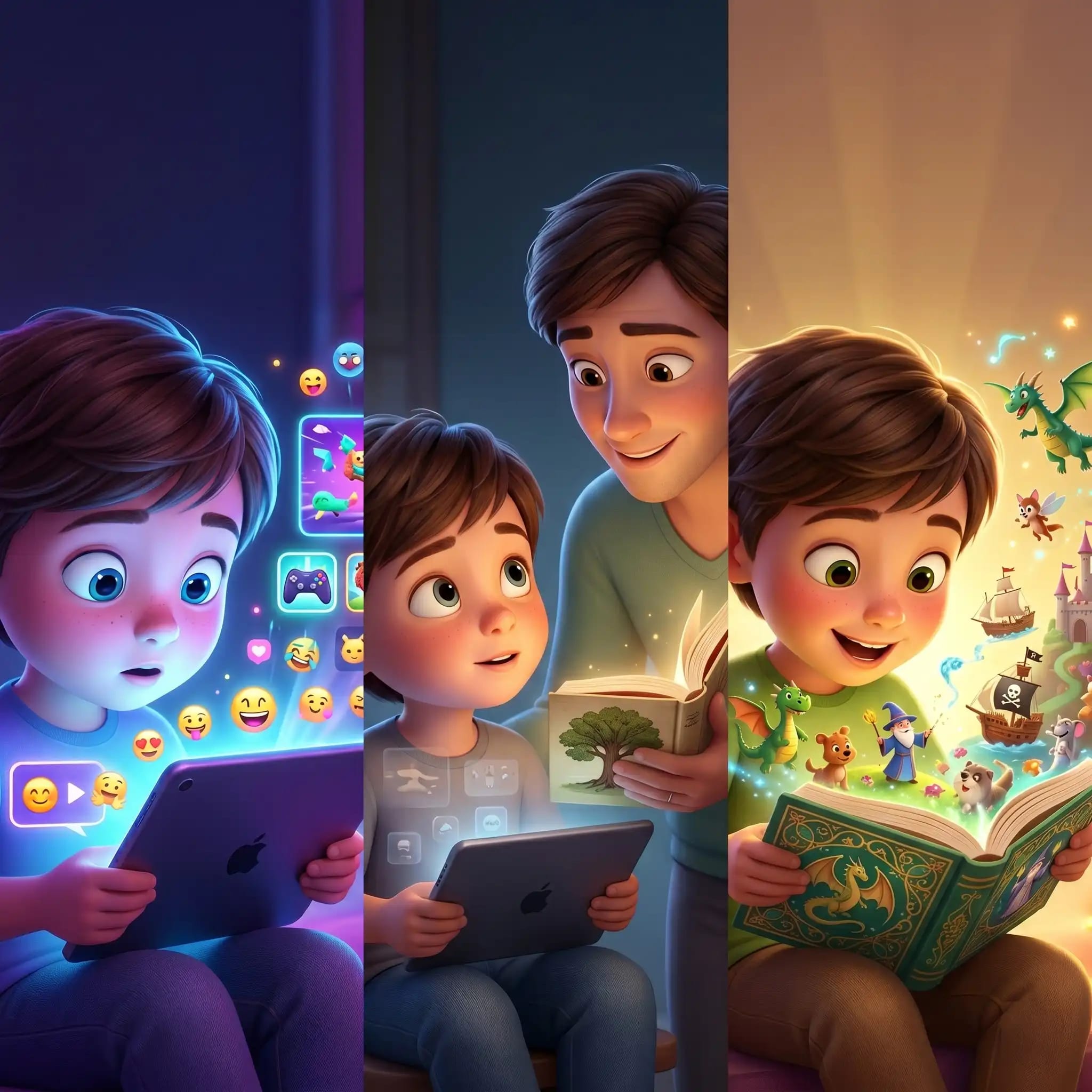
How to Replace Screen Time With Reading (That Kids Enjoy)
We all know the sequence. You decide your child has had enough screen time for the afternoon. You walk in, take the tablet away, and cheerfully suggest, "Why don't you go read a book?" Your child looks at you as if you just suggested they go scrub the driveway with a toothbrush. They groan, flop onto the floor, and loudly declare that they are bored and have absolutely nothing to do.
If your attempt to replace screen time with reading usually ends in tears or a standoff, you are not failing as a parent. You are simply running up against human biology. You cannot just remove a highly stimulating screen, hand over a chapter book, and expect a child's brain to smoothly transition.
If you want to swap screens for books—and actually have them enjoy it—you have to bridge the gap. Here is the science behind why the transition is so hard, and practical, tear-free ways to make reading their new favorite activity.
The Science: Why the "Cold Turkey" Swap Fails
When your child is watching a show or playing a video game, their brain is receiving a steady, effortless stream of dopamine. The screen does all the heavy lifting: it provides the colors, the sounds, the pacing, and the imagination.
The Friction Problem: Reading is the exact opposite. Reading is a high-friction, neurologically demanding task. To read a book, a child has to decode the words, hold the plot in their working memory, and use their own cognitive energy to visualize the story.
When you abruptly turn off a screen and tell them to read, you are asking their brain to go from coasting downhill to sprinting uphill. Their nervous system rebels because it is experiencing a dopamine crash while simultaneously being asked to do heavy cognitive labor. You have to lower the friction.
1. Use "Gateway" Books (Graphic Novels and Comics)
If your child is used to the intense visual stimulation of a tablet, handing them a dense, text-only chapter book will immediately overwhelm them. You need a transition tool.
The Fix: Graphic novels and comic books are the ultimate "gateway" literature. The rich, colorful illustrations provide an immediate hit of visual dopamine, easing the brain's transition away from the screen. At the same time, the child still has to decode the text and follow the narrative sequence. It is the perfect bridge between passive screen consumption and active reading.
2. Implement the "Premack Principle"
If you leave the screen as a default option that can be accessed at any time, a book will never win. You have to change the sequence of your afternoon.
The Fix: Use a behavioral psychology strategy called the Premack Principle (also known as "Grandma's Rule"): First we do the hard thing, then we get the fun thing. Establish a non-negotiable household routine. Say, "First we have a snack, play outside, and do 20 minutes of reading. Then, you can have your screen time." By making reading the gateway to the screen, rather than the punishment for losing it, you completely neutralize the power struggle.
3. The Art of "Strewing"
Marketing companies know that if they want you to buy a candy bar, they put it right at the checkout counter where you don't have to think about it. You need to market books to your kids the same way.
The Fix: If the iPad is sitting on the kitchen counter, but their books are tucked away in a bedroom drawer, the iPad wins. Practice "strewing." Leave high-interest, visually engaging books everywhere. Put a joke book in the bathroom. Leave a Guinness World Records book on the coffee table. Put a magazine about their favorite video game on their pillow. Make books the most accessible, inescapable things in the house.
4. Introduce a "Cool" Reading Mentor
For kids aged 6 to 12, reading to a parent can feel too much like homework. If they view reading as an assignment you are grading, they will run back to the safety of their screens.
The Fix: Outsourcing the routine completely changes the vibe. Pairing your child with a 1-on-1 reading mentor—like an enthusiastic, bright college student—turns reading into a social event. A mentor feels like a cool older sibling who just wants to hang out and talk about awesome stories. This removes the parent-child friction, turning reading from a solitary chore into a highly engaging, peer-to-peer connection that easily competes with digital entertainment.
5. Leverage the Magic of Audiobooks
Sometimes, a child’s brain is simply too tired to decode words after a long day at school. They want to zone out, which is why they crave the screen.
The Fix: Swap the visual screen for an audio experience. Audiobooks are an incredible tool for reluctant readers. They allow the child to get lost in a complex, thrilling plot without the exhausting labor of sounding out words. Let them build a LEGO tower or color in a sketchbook while listening to an audiobook. It satisfies their need to relax and be entertained while still expanding their vocabulary and attention span.
The Bottom Line
You don't have to banish screens forever to raise a reader. You just have to tilt the scales. By offering highly visual books, establishing a "reading-first" routine, and making the experience social rather than solitary, you can help your child discover that the pictures they build in their own mind are far better than anything on a screen.
Share the Knowledge! Are you actively trying to balance screens and books in your house? Hit the share button to pass this stress-free guide to a fellow parent who could use some fresh ideas today!
Responses
No responses yet. Be the first to share your thoughts.