Should Kids Read Comics or “Real” Books? (What Parents Should Know)
Do graphic novels count as "real" reading? Learn what cognitive psychology says about comics, visual literacy, and how to raise a confident reader.
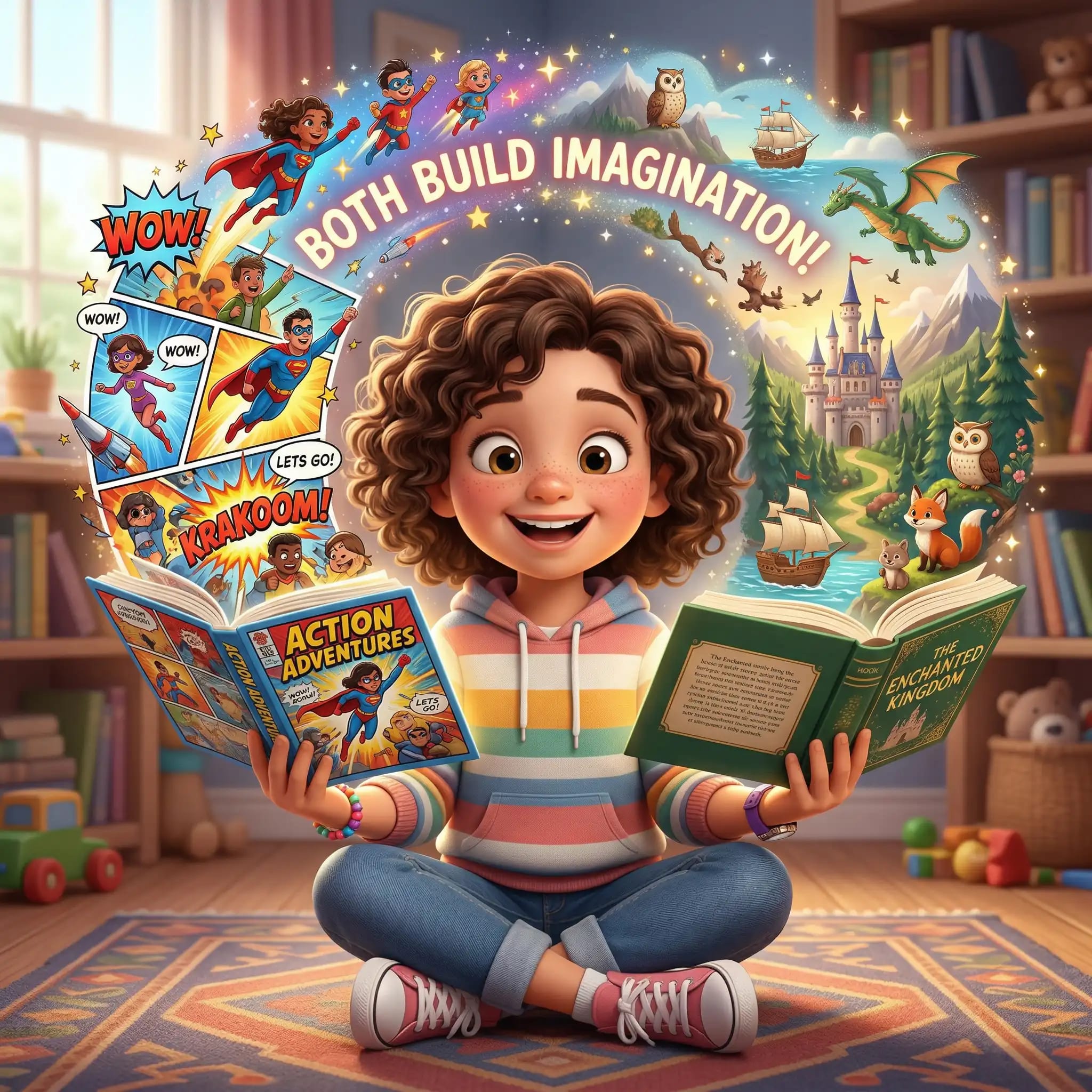
Let me paint a picture that might feel a little too familiar. You take your child to the bookstore or the local library. You gently steer them toward the section with the classic chapter books—the ones you loved growing up. You pull a beautiful, text-heavy novel off the shelf.
Your child glances at it, politely puts it back, and immediately makes a beeline for the graphic novel section. They emerge clutching the newest Dog Man, Amulet, or Percy Jackson graphic adaptation, beaming with excitement.
You buy it, of course. But on the car ride home, a familiar, heavy question weighs on your mind:
“Is this actually counting as reading? Shouldn’t they be reading 'real' books by now?”
If you have ever felt a pang of guilt over your child’s love for comics or graphic novels, I want you to take a deep breath and let it go.
There is a stubborn myth in parenting circles that graphic novels are just "lazy reading" or the junk food of the literary world. But cognitive psychologists and literacy researchers have a very different take. Let’s look at the science of why comics are not just "real" reading—they are actually a secret weapon for building advanced, lifelong readers.
1. The Myth of "Lazy Reading" vs. The Reality of Visual Literacy
We often assume that because a book has pictures, the brain isn't working as hard. Actually, reading a graphic novel requires a highly complex set of cognitive skills known as visual literacy.
When we read a traditional paragraph, the author hands us the setting, the character's emotions, and the action on a silver platter using words. In a graphic novel, the reader has to actively build the story in their own mind. They have to read the text in the dialogue balloon, analyze the character’s facial expression in the artwork, and then bridge the gap between those two pieces of information.
Furthermore, the reader's brain has to figure out what happened between the panels. If panel A shows a character standing on a diving board, and panel B shows a splash in the water, the reader's brain has to infer the jump. Researcher Neil Cohn refers to this as "visual language," and navigating it requires the exact same kind of critical thinking and inference skills we want kids to use when analyzing complex literature (Cohn, 2012).
As someone who deeply appreciates how intentional design and layout shape our understanding, I can assure you: the artwork in these books isn't a crutch. It's a demanding, multi-layered narrative tool.
2. The Vocabulary Surprise: Comics Pack a Punch
One of the biggest worries parents have is that comics are dumbing down their child's vocabulary. Science says the exact opposite.
In a landmark study analyzing the vocabulary of various media, researchers found that comic books actually contain more rare, high-level vocabulary words than the average adult prime-time television show, and significantly more than the daily conversation between college graduates (Hayes & Ahrens, 1988).
Because graphic novels are constrained by space, the authors can't use filler words. Every single word in a speech bubble has to earn its keep, which often leads to incredibly rich, concise, and advanced vocabulary. The best part? If a child encounters a word they don't know, the surrounding artwork provides immediate context clues, making them far more likely to absorb and remember the new word.
3. The 8-to-14 Window: Preventing the Reading Drop-Off
There is a critical window, right around ages 8 to 14, where we see a massive drop-off in reading for pleasure. Books get longer, the font gets smaller, and suddenly, reading feels suspiciously like homework.
Graphic novels are the ultimate bridge over this gap. They offer the deep, complex plots of a chapter book but deliver them with the quick, rewarding pacing of a visual medium.
If your child is in this age group, the goal isn't to force them into heavy texts; the goal is to keep them turning pages. In fact, connecting them with an older peer or a college-aged reading mentor to discuss these graphic novels can be life-changing. When a younger child hears an older student validate their favorite comic, dive into the character arcs, and discuss the themes, it completely shifts their identity. They stop thinking, "I only read easy books," and start believing, "I am a reader who analyzes stories."
4. Confidence is the Ultimate Comprehension Tool
Dr. Stephen Krashen, one of the world's leading experts on linguistics and reading, has spent his career studying "Free Voluntary Reading." His conclusion is simple but profound: children learn to read by reading something they actually want to read (Krashen, 2004).
When a child finishes a 200-page graphic novel in a single afternoon, they feel an immense sense of accomplishment. That feeling of success wires their brain to associate reading with joy rather than frustration. A child armed with reading confidence will eventually pick up that classic text-heavy novel when they are ready. But a child who feels shamed for their reading choices will simply put the book down and turn on a screen.
The Takeaway for Parents
Next time your child brings you a stack of graphic novels, don't ask them to put one back in exchange for a "real" book. Celebrate it. Ask them about the art style. Ask them how the illustrator showed that a character was angry without using any words.
You aren't letting them take the easy way out. You are letting them build a complex, visually literate brain while falling in love with storytelling.
References Cited:
Cohn, N. (2012). Comics, linguistics, and visual language: The past and future of a field. In Linguistics and the Study of Comics (pp. 92-118). Palgrave Macmillan.
Hayes, D. P., & Ahrens, M. G. (1988). Vocabulary simplification for children: A special case of ‘motherese’?. Journal of Child Language, 15(2), 395-410.
Krashen, S. D. (2004). The power of reading: Insights from the research (2nd ed.). Libraries Unlimited.