What Happens to Kids' Brains With Too Much Screen Time
Worried about your child's screen habits? Discover the real science behind what screens do to a developing brain and how to reverse the effects today.
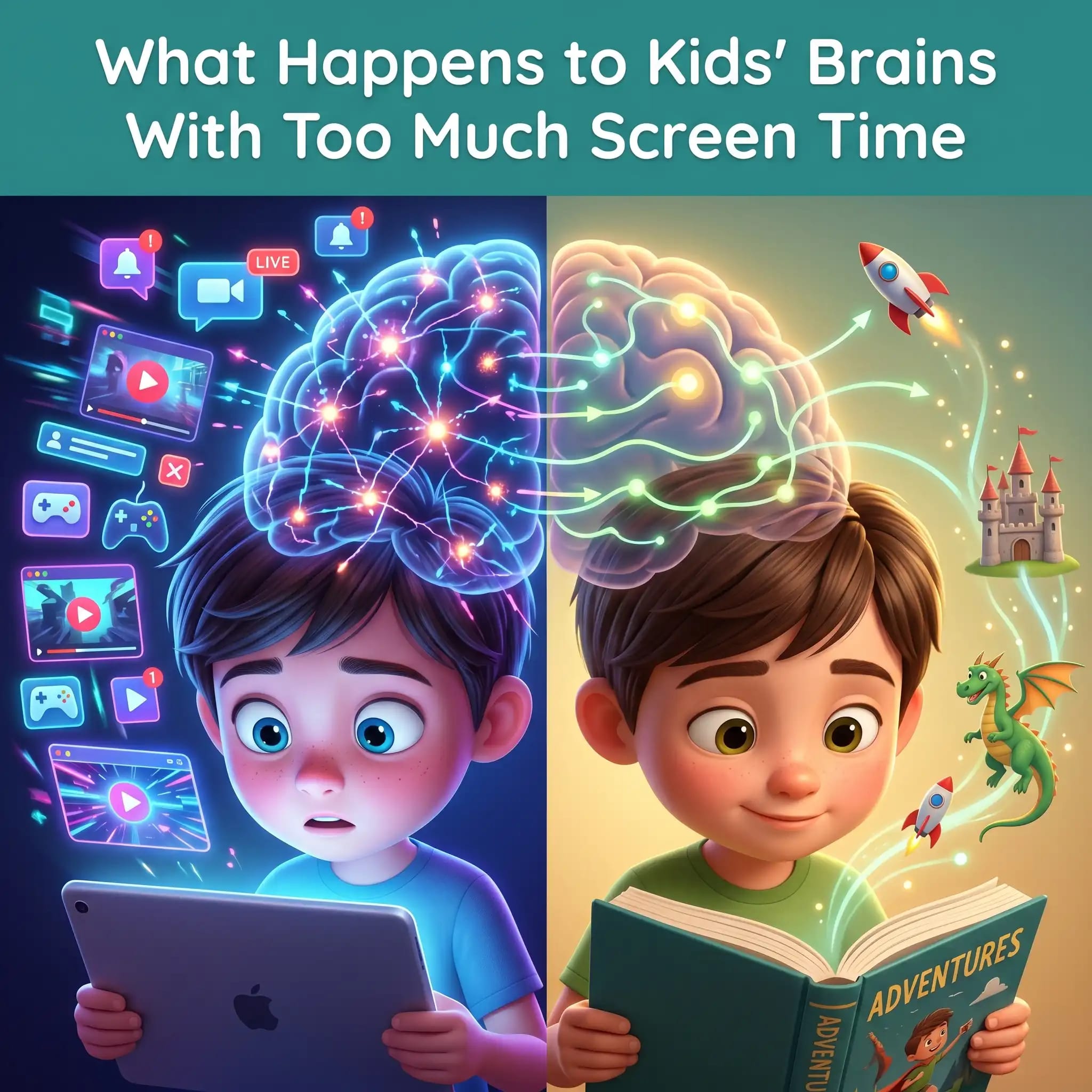
What Happens to Kids’ Brains With Too Much Screen Time
It is the universal modern parenting worry. You hand your child a tablet so you can take a work call, make dinner, or just sit in silence for twenty minutes. But as you watch them zone out, staring blankly at the flashing animations, the guilt creeps in: What is this actually doing to their brain?
For years, the warnings about screen time felt vague—"It rots their brain!" or "It makes them hyper!" But today, we don't have to guess. Thanks to advanced MRI technology, scientists can literally look inside the heads of children to see exactly how digital devices shape their neural pathways.
Before you panic and throw your TV in the trash, take a deep breath. One movie night isn't causing brain damage. But a chronic, heavy daily diet of screens does physically alter brain structure. Here is the fascinating, no-nonsense science of what happens to a child's brain on screens, and the surprisingly simple ways to reverse it.
1. The "White Matter" Gap: Slower Processing
Think of the brain like a city. The "gray matter" contains the buildings where information is processed, and the "white matter" is the highway system that connects the buildings so they can communicate. A strong, well-organized highway system means a child can process language, focus, and learn quickly.
The Science: A landmark 2020 study published in JAMA Pediatrics (Hutton et al.) used MRI scans to map the brains of young children (ages 3 to 5). They found that children who used screens for more than the recommended one hour a day without parental involvement had lower structural integrity and less organization in their brain’s white matter tracts.
The Result: Because those "highways" aren't as robust, these children often test lower in language and literacy skills, expressive vocabulary, and cognitive processing speed. Passive screen time essentially under-develops the brain's communication network.
2. Premature Thinning of the Cortex
The cerebral cortex is the outermost layer of the brain, responsible for processing sensory information, language, and high-level reasoning. As we age into adulthood, the cortex naturally thins out. But screens seem to be hitting the fast-forward button on this process.
The Science: The National Institutes of Health (NIH) is currently conducting the Adolescent Brain Cognitive Development (ABCD) study, the largest long-term study of brain development in children. Early MRI data from over 4,500 children revealed a startling trend: kids who spend more than seven hours a day on screens show a premature thinning of the brain’s cortex.
The Result: While researchers are still studying the long-term implications, premature cortical thinning is linked to lower cognitive test scores and a reduced ability to process complex, multi-sensory information in the real world.
3. The Dopamine Hijack: Why Real Life Feels "Boring"
When a child plays a fast-paced video game or watches rapid-fire short videos, their brain is flooded with dopamine—the "feel-good" reward chemical.
The Mechanism: The brain is highly adaptable. When it gets used to receiving massive, effortless hits of dopamine from a screen, it shifts its baseline. It begins to demand that high level of stimulation just to feel "normal."
The Result: When you turn the screen off, dopamine plummets. Everyday activities that require sustained effort for a delayed reward—like reading a book, building a tower of blocks, or listening to a teacher—suddenly feel agonizingly boring. Their brain literally lacks the chemical motivation to engage with the slow pace of the real world.
4. The "Use It or Lose It" Pruning Process
During childhood, the brain experiences a massive overproduction of synapses (neural connections). As the child grows, the brain goes through a process called "synaptic pruning." It operates on a strict use it or lose it policy.
If a child spends three hours a day physically climbing trees, manipulating 3D objects, and talking to peers, the brain strengthens motor, spatial, and social pathways. If a child spends those same three hours passively swiping a flat glass screen, the brain reinforces passive visual processing and actively prunes away the under-utilized motor and interpersonal pathways.
The Good News: Neuroplasticity
If reading that science made your chest tight, let it go. Here is the most important scientific fact of all: A child's brain is incredibly plastic. Neuroplasticity means the brain can physically wire and re-wire itself based on its environment. The damage is not permanent. If you change the inputs, the brain will immediately start building new, healthier pathways.
Here is how you help their brain heal and grow:
Prescribe Heavy Movement: Vigorous, heart-pumping exercise releases Brain-Derived Neurotrophic Factor (BDNF). Think of BDNF as Miracle-Gro for the brain. It encourages the growth of new neurons and repairs cognitive pathways. Swap the iPad for 30 minutes of tag, biking, or wrestling.
Bring Back 3D Play: Give them toys that require physical manipulation and spatial reasoning. LEGOs, wooden blocks, and Play-Doh force the brain's "highways" to light up and communicate.
Read Physical Books: Reading is the ultimate antidote to passive screen time. It forces the brain to actively decode language, build white matter tracts, and practice sustained focus.
The Bottom Line
Screens are a permanent part of our world, and using them to survive a busy afternoon does not make you a failure. But understanding the science empowers us to set better boundaries. You don't have to ban technology completely; you just have to ensure it isn't crowding out the physical movement, boredom, and hands-on play that your child's brain desperately needs to thrive.
What is one small, screen-free activity your child used to love that you could gently reintroduce to their routine this week?
Responses
No responses yet. Be the first to share your thoughts.