What to Do If Your Child Finds Books Boring
Struggling with a child who finds books boring? Learn the real reasons behind it and practical, psychology-backed ways to make reading engaging and enjoyable.

What to Do If Your Child Finds Books Boring
“I don’t like reading.”
Few sentences frustrate parents more than this.
You buy books. You encourage gently. Sometimes, you even insist.
But your child still avoids reading—choosing screens, games, or anything else instead.
At this point, it’s easy to assume:
“Maybe my child just isn’t interested in books.”
But here’s what’s actually happening:
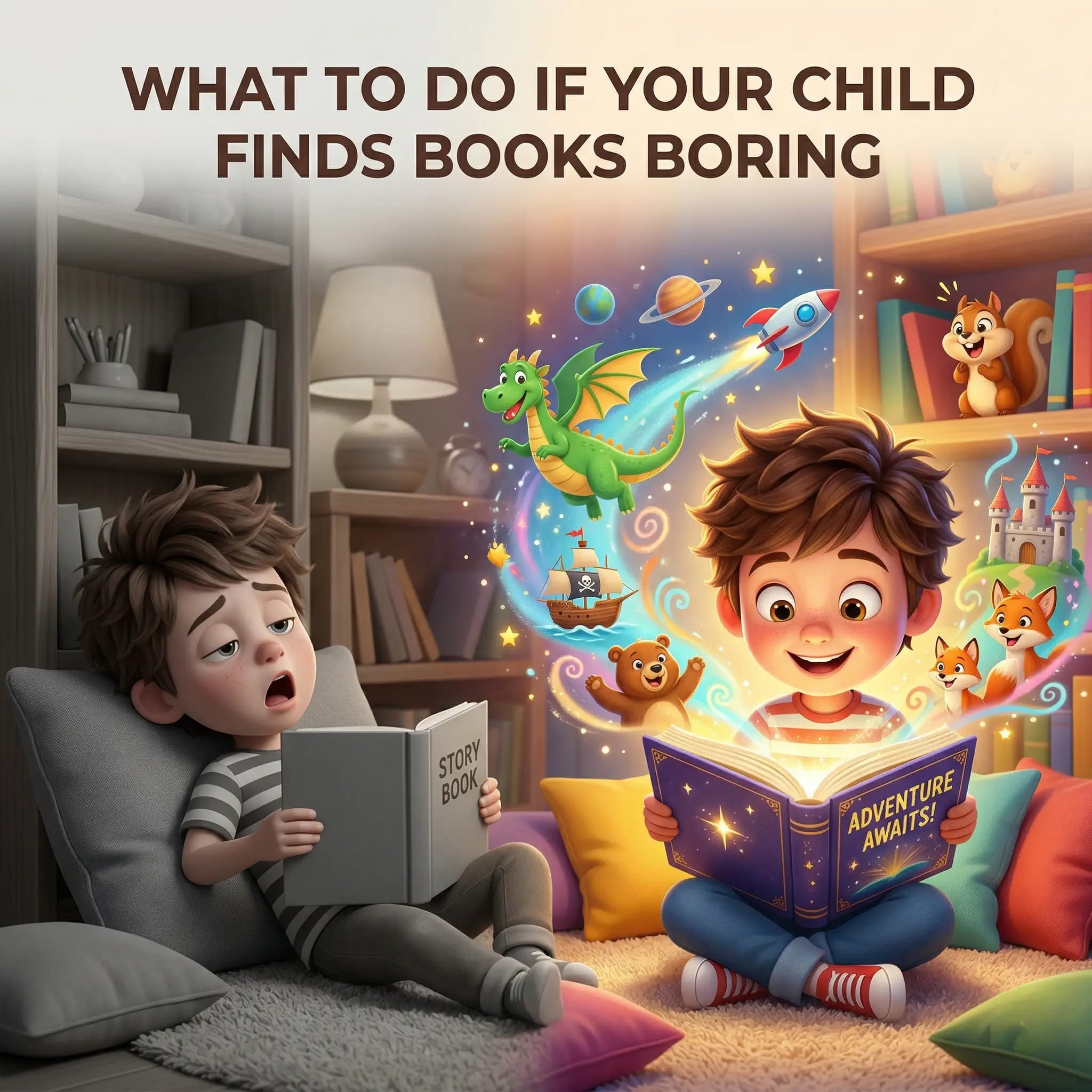
Your child doesn’t find books boring. They find their current experience with books boring.
And that’s something you can change.
Why Children Say “Books Are Boring” (The Real Reasons)
Before fixing the problem, we need to understand it.
Because boredom isn’t random—it’s a signal.
1. The Book Doesn’t Match Their Brain
Every child processes stories differently.
Some want:
Fast action
Immediate stimulation
Others prefer:
Deep narratives
Emotional journeys
When the book’s pace doesn’t match the child’s cognitive style, the brain disengages.
According to Csikszentmihalyi’s Flow Theory (1990), engagement happens when challenge and skill are balanced. If a task feels too slow or too difficult, it creates boredom or anxiety.
👉 Many children quit reading not because it’s hard— but because it doesn’t feel stimulating enough.
2. Reading Feels Like a Task, Not an Experience
For many kids, reading is associated with:
Homework
School pressure
“Finish this chapter”
This creates a mental shift:
👉 Reading = obligation
And once something feels like a task, intrinsic motivation drops.
Research by Deci & Ryan (1985) shows that external pressure reduces natural interest—even in activities children might otherwise enjoy.
3. Screens Have Rewired Their Expectations
Let’s be honest—books are competing with:
YouTube
Reels
Games
These platforms are designed for:
Instant gratification
High stimulation
Continuous novelty
Compared to that, books feel:
Slow
Effortful
Less rewarding (initially)
This doesn’t mean books are worse.
It means:
The child’s brain has adapted to faster reward cycles.
4. Lack of Emotional Connection
Children don’t continue reading because of words.
They continue because of connection:
“I like this character”
“I want to know what happens next”
“This reminds me of something”
Without this, reading feels empty.
According to Rosenblatt’s Transactional Theory (1978), meaning in reading comes from the interaction between reader and text—not just the text itself.
5. They’ve Had Repeated “Failed” Reading Experiences
Imagine this pattern:
Book too hard → struggle
Book too boring → quit
Book forced → resist
After a few cycles, the brain concludes:
👉 “Reading is not for me.”
This becomes an identity—not just a preference.
What Actually Works (And What Doesn’t)
Let’s move beyond theory.
Here’s how to shift your child from resistance to interest.
Step 1: Stop Trying to “Fix” Reading Immediately
This sounds counterintuitive.
But the more you push reading, the more resistance builds.
Instead:
Pause expectations
Remove pressure
Reset the experience
👉 The goal is not to make them read today. 👉 The goal is to make them open to reading again.
Step 2: Start With Engagement, Not Books
If your child finds books boring, don’t start with books.
Start with:
Stories
Conversations
Curiosity
For example:
Instead of: 👉 “Read this book”
Try: 👉 “What do you think would happen if…?”
This activates imagination—without resistance.
Step 3: Introduce “Easy Wins”
Children need early success to build interest.
So choose:
Short books
Visually engaging content
Fast-paced stories
Even if they seem “too easy.”
According to Bandura’s Self-Efficacy Theory (1977), confidence builds through small successful experiences.
👉 A child who finishes easy books will naturally move to harder ones. 👉 A child who struggles early will avoid reading entirely.
Step 4: Let Them Quit Books (Yes, Really)
One of the biggest mistakes parents make:
👉 Forcing children to finish books
But adults don’t do this.
If a book is boring, we stop reading.
Children deserve the same freedom.
This builds:
Ownership
Exploration
Honest preference
Step 5: Make Reading Social, Not Solo
Reading is often presented as:
👉 Sit quietly. Read alone.
But for many children, this is unnatural.
They enjoy:
Interaction
Conversation
Shared experiences
So try:
Reading together
Discussing stories
Asking open-ended questions
This transforms reading into something alive.
Step 6: Use Curiosity Hooks
Instead of handing over a book, create intrigue.
For example:
“This story has a twist you won’t expect.”
“The main character makes a really strange decision.”
“Let’s guess what happens next.”
Curiosity is a powerful driver.
According to Loewenstein’s Information Gap Theory (1994), curiosity arises when there’s a gap between what we know and what we want to know.
Step 7: Reduce Screen Dependency (Gradually)
You don’t need to eliminate screens overnight.
But you do need to rebalance stimulation levels.
Start with:
Small screen-free windows
Replacing—not removing—screen time
For example:
👉 Instead of “No screen time” 👉 Try “Let’s try this story for 10 minutes first”
This feels less restrictive.
Why Most Solutions Fail
Most advice focuses on:
More books
Better books
Strict routines
But the real issue is:
The child’s relationship with reading
Until that changes, nothing sticks.
The Shift That Changes Everything
When reading becomes:
👉 Interactive 👉 Personal 👉 Enjoyable
Children don’t need to be pushed.
They start pulling toward it.
How Bookstaken Helps Children Who Find Books Boring
Children rarely change their reading habits alone.
They need:
The right book
The right pace
The right guidance
At Bookstaken, reading isn’t treated as:
👉 “Sit and read quietly”
It’s treated as:
👉 “Let’s explore something interesting together”
Here’s what makes the difference:
1:1 sessions keep children engaged
Mentors adapt to each child’s personality
Stories are discussed, not just read
Curiosity is built intentionally
So instead of saying:
👉 “Books are boring”
Children begin to say:
👉 “What are we reading next?”
And that’s the turning point.
Final Thought
When a child says “books are boring,” they’re not rejecting reading.
They’re reacting to:
Wrong book choices
Lack of engagement
Past experiences
Your job is not to force reading.
Your job is to reshape the experience.
Because once reading feels:
Interesting
Personal
Enjoyable
You won’t need to convince your child anymore.
They’ll come back to books on their own.
And that’s when real reading begins.