How to Build a Personal Reading Taste in Children (Complete Guide for Parents)
Learn how to help your child develop their own reading taste, explore books independently, and build a lifelong reading habit—without pressure.
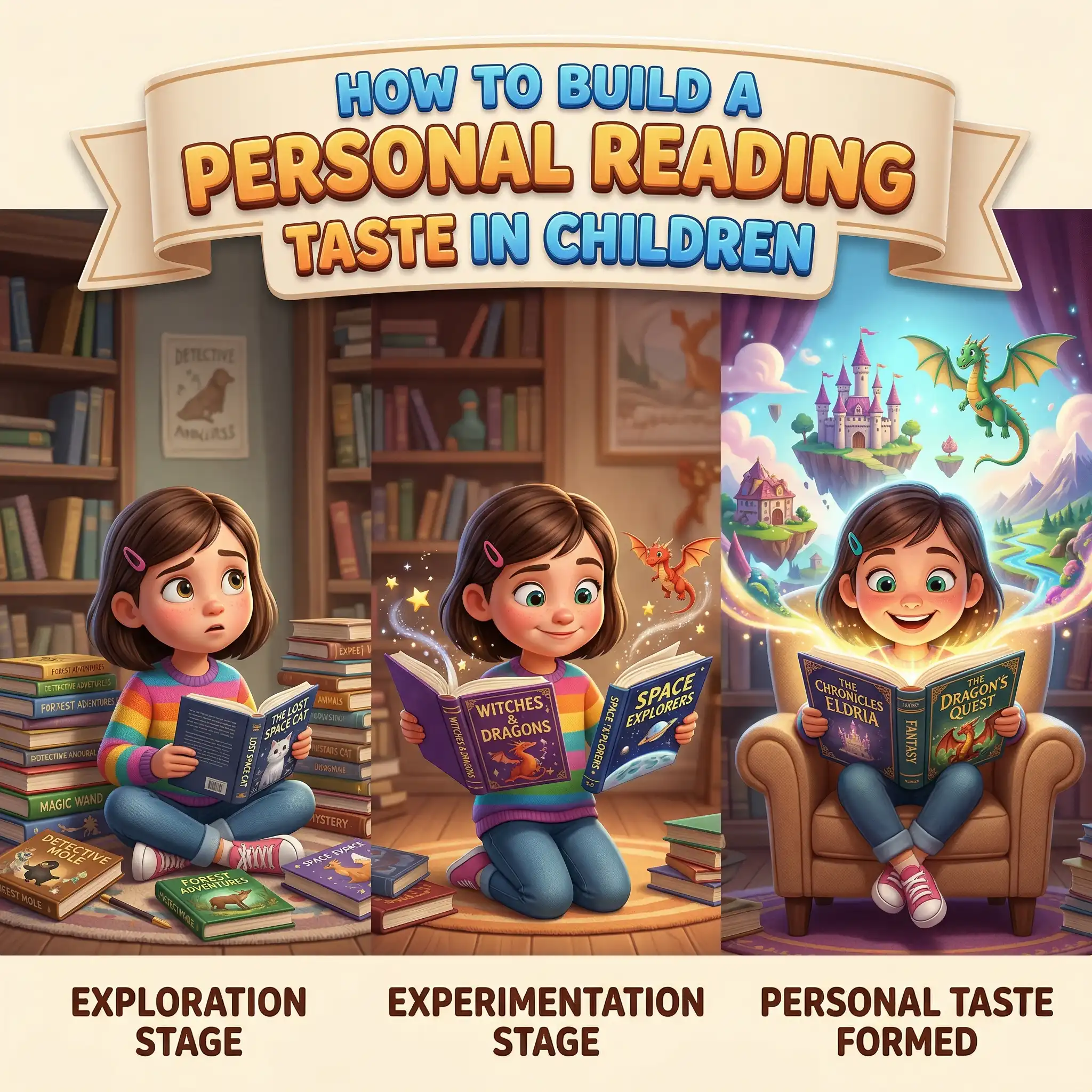
How to Build a Personal Reading Taste in Children
Most parents focus on getting their child to read.
But there’s a deeper goal that often gets missed:
Helping your child develop their own reading taste
Because the difference is huge.
A child who is told what to read:
Depends on external guidance
Reads only when asked
A child who develops reading taste:
Chooses books independently
Explores new ideas
Reads consistently without pressure
And this is what creates a lifelong reader.
What Is “Reading Taste” (And Why It Matters)
Reading taste is simply:
👉 A child’s ability to know what they enjoy reading—and seek more of it
It includes:
Preferred genres
Writing styles
Themes and topics
Types of characters
Think of it like food.
You don’t force someone to eat everything. Over time, they discover what they like.
Reading works the same way.
Why Many Children Never Develop Reading Taste
Most children are exposed to:
School reading lists
“Recommended books”
Parent-selected material
While useful, this creates a problem:
👉 Reading becomes externally controlled
According to Deci & Ryan (1985), autonomy is essential for intrinsic motivation. Without choice, engagement drops—even if the activity is valuable.
So children:
Follow instructions
Don’t explore
Never build personal preference
The Hidden Consequence: Dependency on Parents
If children always rely on:
👉 “What should I read next?”
They never learn:
👉 “What do I feel like reading?”
This creates:
Low initiative
Limited curiosity
Weak reading habits
The Shift: From Selection to Exploration
Instead of asking:
👉 “Which book is best for my child?”
Start asking:
👉 “How can my child learn to choose books?”
Because long-term reading depends on:
Decision-making
Exploration
Self-awareness
Step-by-Step: Building Reading Taste in Children
Step 1: Increase Exposure (Without Forcing Completion)
Taste develops through exposure.
So give access to:
Different genres
Different formats
Different writing styles
But here’s the key:
👉 Don’t expect them to finish everything
Sampling is more important than completion.
Step 2: Normalize Dropping Books
One of the most powerful shifts:
👉 Allow children to leave books unfinished
This teaches:
Preference matters
Exploration is okay
Reading is personal
Adults do this naturally.
Children should too.
Step 3: Ask Reflection Questions (Not Test Questions)
After reading, avoid:
👉 “What happened in the story?”
Instead ask:
“Did you like it?”
“What was interesting?”
“What didn’t you enjoy?”
This builds:
👉 Awareness of preference
According to metacognition research (Flavell, 1979), reflecting on experiences improves learning and decision-making.
Step 4: Track Patterns (Gently)
Over time, patterns emerge.
You might notice:
They prefer fast-paced stories
They enjoy emotional narratives
They like learning-based books
Help them see this:
👉 “You seem to enjoy mystery stories more, right?”
This builds identity:
👉 “I like this kind of reading”
Step 5: Avoid Over-Correcting Their Choices
Sometimes children choose:
Very easy books
Repetitive content
Unusual genres
Parents often step in:
👉 “Read something better”
But this disrupts exploration.
Instead:
👉 Let their taste evolve naturally
Quality can be introduced gradually—without rejecting their preferences.
Step 6: Create a Low-Pressure Reading Environment
Reading taste grows in environments where:
There’s no pressure
There’s freedom to explore
There’s room for curiosity
Avoid turning reading into:
A task
A performance
A requirement
Step 7: Introduce “Adjacent Books”
Once you notice a preference, expand it.
For example:
If they like: 👉 Mystery
Introduce: 👉 Adventure + mystery 👉 Puzzle-based stories
This gently broadens taste without resistance.
The Psychology Behind Reading Taste
Reading taste is driven by:
1. Identity Formation
Children start seeing themselves as:
“Someone who likes fantasy”
“Someone who enjoys facts”
According to Erikson’s Development Theory (1968), identity plays a key role in behavior consistency.
2. Reward Systems
When children enjoy a book:
Dopamine reinforces the experience
They seek similar experiences
This builds habit loops.
3. Cognitive Ease
Children prefer content that feels:
Understandable
Engaging
Aligned with their thinking style
Why Many Parents Feel Stuck
Even after trying different books, parents struggle because:
👉 They are still controlling the process
Instead of:
👉 Letting the child explore
This slows down taste development.
The Missing Piece: Guided Discovery
Children don’t always know how to explore effectively.
They need:
Exposure
Reflection
Gentle guidance
Without this, exploration becomes random—and often frustrating.
How Bookstaken Helps Children Build Their Reading Taste
At Bookstaken, the focus is not just on reading more.
It’s on helping children:
👉 discover what they enjoy reading
Here’s how:
Mentors expose children to different genres
Sessions include discussions about preferences
Children are encouraged to express opinions
Reading becomes a guided exploration, not instruction
So instead of:
👉 “Here’s what you should read”
Children experience:
👉 “Let’s figure out what you enjoy”
Over time, this builds:
Independent choice
Strong reading identity
Consistent reading habits
Final Thought
Reading taste is not built in a day.
It is developed through:
Exposure
Exploration
Reflection
Your role as a parent is not to:
👉 Choose the perfect books every time
But to:
👉 Help your child understand what they enjoy
Because when a child knows:
👉 “This is what I like to read”
They don’t need reminders.
They don’t need pressure.
They don’t need rewards.
They simply pick up a book—
And keep going.
And that’s when reading becomes truly theirs.