How to Turn a Non-Reader Into a Curious Reader (Step-by-Step Guide for Parents)
Struggling with a child who doesn’t like reading? Learn how to turn a non-reader into a curious reader using psychology-backed strategies that actually work.
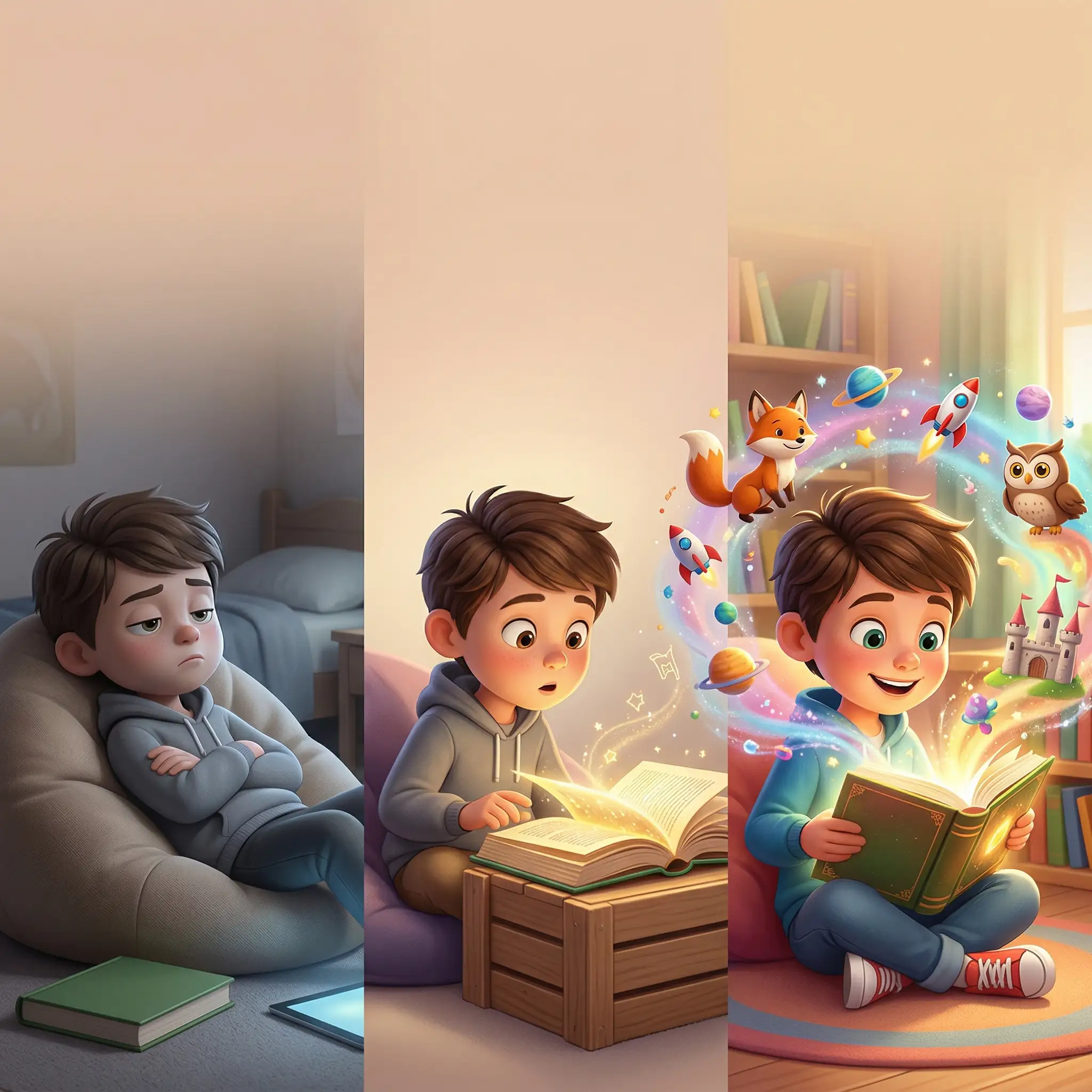
How to Turn a Non-Reader Into a Curious Reader
Every parent wants their child to read.
Not just for school — but for thinking, imagination, and growth.
Yet many parents face the same challenge:
“My child just isn’t interested in reading.”
They try:
Buying new books
Setting routines
Encouraging gently
But nothing seems to stick.
At some point, it starts to feel like:
👉 “Maybe my child is just not a reader.”
But here’s the truth:
There is no such thing as a “non-reader” child. There are only children who haven’t found the right way into reading.
And once that entry point is discovered, everything changes.
Why Some Children Become Non-Readers
Before solving this, we need to understand how it happens.
Because children are not born disliking reading.
They become non-readers through experiences.
1. Reading Starts With Effort, Not Reward
When children first encounter books, they experience:
Decoding words
Understanding meaning
Sitting still
This requires cognitive effort.
But the reward (enjoyment) is delayed.
In contrast:
Screens give instant reward
Games give immediate feedback
According to Kahneman’s Cognitive Effort Theory (2011), the brain naturally avoids high-effort, low-immediate-reward activities.
👉 So children drift toward easier alternatives.
2. Early Friction Creates Lasting Resistance
If early reading experiences involve:
Difficult books
Corrections
Pressure
The brain associates reading with discomfort.
Over time, this becomes:
👉 “I don’t like reading”
Even though the root cause is how reading was introduced.
3. Lack of Identity as a “Reader”
Children adopt identities based on repeated experiences.
If a child repeatedly feels:
“This is hard”
“Others are better”
“I don’t enjoy this”
They internalize:
👉 “Reading is not for me”
According to Dweck’s Mindset Theory (2006), these beliefs strongly influence behavior and persistence.
The Real Goal: Build Curiosity, Not Compliance
Most parents focus on:
👉 “How do I make my child read?”
But the better question is:
👉 “How do I make my child curious about reading?”
Because curiosity drives:
Exploration
Attention
Consistency
And reading naturally follows.
Step-by-Step: Turning a Non-Reader Into a Curious Reader
This is not about quick fixes.
It’s about changing how your child experiences reading.
Step 1: Remove the Pressure Around Reading
If reading currently feels forced, start here.
Stop insisting on daily reading
Remove targets like “finish this book”
Avoid corrections while they read
This creates psychological safety.
👉 Without this, no strategy works.
Step 2: Reintroduce Stories (Without Books)
Before books, children fall in love with stories.
So bring stories back through:
Conversations
Audio stories
Storytelling at bedtime
This lowers effort and rebuilds interest.
According to Bruner (1991), humans are naturally wired for narrative thinking—stories are easier to engage with than structured text.
Step 3: Find Their Curiosity Trigger
Every child has a curiosity entry point.
It could be:
Space
Animals
Mystery
Sports
Fantasy
Your job is to observe, not guess.
Watch:
What they talk about
What they watch repeatedly
What excites them
👉 That’s your starting point.
Step 4: Use “Bridge Content”
Don’t jump directly into traditional books.
Use content that sits between:
👉 Entertainment and reading
Examples:
Graphic novels
Illustrated books
Interactive stories
This reduces friction while maintaining engagement.
Step 5: Make Reading Interactive
Non-readers struggle with passive reading.
So make it active:
Ask “What do you think happens next?”
Let them predict outcomes
Discuss characters
According to Vygotsky’s Social Development Theory (1978), learning improves through interaction and guided participation.
👉 Interaction transforms reading from effort → engagement.
Step 6: Celebrate Curiosity, Not Completion
Avoid saying:
👉 “Good job, you finished the book”
Instead say:
👉 “That’s an interesting thought” 👉 “I like how you noticed that”
This shifts focus from outcome to thinking.
Step 7: Build Momentum With Small Wins
Start with:
Short reading sessions (5–10 minutes)
Easy, engaging books
Gradually increase complexity.
This builds:
Confidence
Attention span
Positive association
The Turning Point Most Parents Miss
There’s a moment when:
👉 A child becomes slightly interested
Most parents push harder here.
But the right move is:
👉 Deepen the experience
Ask questions. Explore ideas. Stay in the moment.
Because this is where:
Interest turns into curiosity
Why Independent Reading Doesn’t Work (Initially)
Many parents expect children to:
👉 Sit alone and read
But non-readers lack:
Habit
Confidence
Engagement
So independent reading feels overwhelming.
They need:
👉 Guided experiences first
The Role of Guided Reading in Building Readers
Guided reading provides:
Structure without pressure
Interaction without distraction
Support without control
This helps children:
Stay engaged
Understand better
Enjoy the process
How Bookstaken Helps Non-Readers Become Curious Readers
At Bookstaken, the focus is not on:
👉 “Making children read”
It’s on:
👉 “Helping them discover why reading is interesting”
Here’s how:
Each child is matched with a mentor who adapts to their personality
Sessions are conversational, not instructional
Stories are explored, not just read
Curiosity is built step by step
So instead of:
👉 “Read this chapter”
Children experience:
👉 “Let’s figure this out together”
And that changes their entire relationship with reading.
Final Thought
No child is truly a non-reader.
They are simply:
Uninterested
Overwhelmed
Or disconnected from the experience
Your goal is not to force reading.
It’s to ignite curiosity.
Because once a child becomes curious:
They ask questions
They seek answers
They explore stories
And reading stops being something you teach—
It becomes something they choose.
And that’s when a lifelong reader is born.