Practical Ways to Reduce Screen Time at Home (Without the Fights)
Is your family's screen time creeping out of control? Discover science-backed, stress-free, and practical ways to reduce screen time at home.
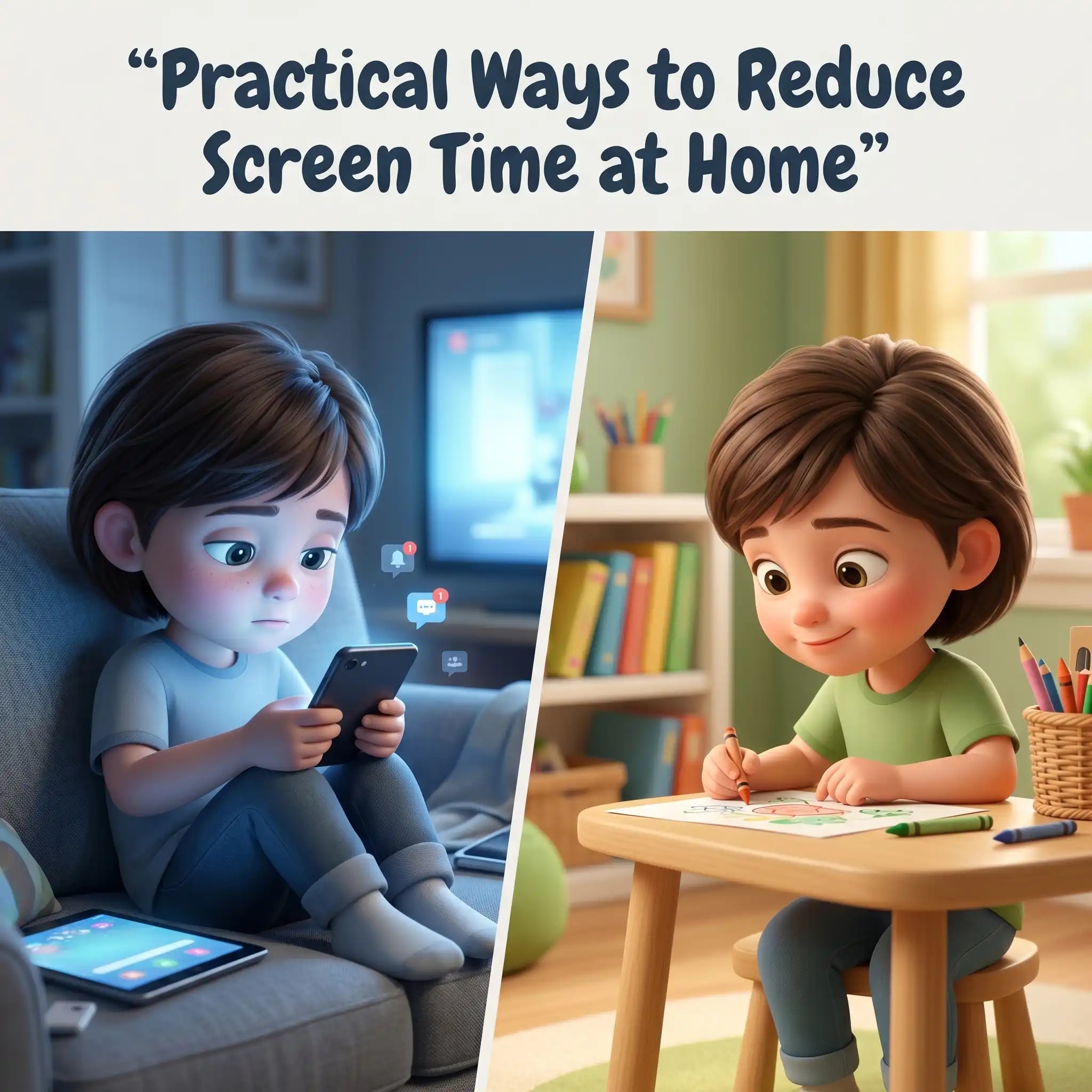
Practical Ways to Reduce Screen Time at Home (Without the Fights)
If you have ever looked around your living room on a Tuesday evening and realized that every single person in your family is silently staring at a glowing rectangle, you are not alone.
In the modern home, screens are the default. They entertain, they educate, and let’s be honest—they give parents a much-needed break. But when screen time slowly creeps up and begins replacing family conversation, outdoor play, or a good night’s sleep, it’s time to hit the reset button.
The thought of reducing screen time usually fills parents with dread, anticipating whining, begging, and epic meltdowns. But cutting back on digital devices doesn't have to be a battle of wills. By utilizing environmental design and behavioral science, you can effortlessly lower your family’s screen time. Here are the most practical, research-backed ways to reclaim your home from screens.
The Science: What Actually Works?
When we try to reduce screen time, we usually just tell our kids, "Turn that off!" But willpower alone is a terrible strategy for building habits.
The Science: A comprehensive systematic review of parental interventions published in ResearchGate (2022) analyzed the most effective ways to reduce screen time in children. The researchers found that simply telling kids about the dangers of screens doesn't work. The most successful interventions relied on environmental changes: specifically, removing screens from the child's bedroom, setting explicit behavioral goals, and actively offering alternative offline activities.
To reduce screen time effectively, you have to stop fighting your child and start changing their environment. Here is how to do exactly that.
1. Establish a "Screen-Free Bedroom" Rule
If there is only one boundary you set in your home, make it this one. When a child has a television, tablet, or smartphone in their bedroom, their screen time naturally skyrockets, and their health takes a direct hit.
The Science: A recent 2024 cross-sectional analysis published in the National Library of Medicine (PMC) on school-aged children found that kids with high screen time—particularly in the bedroom—had significantly lower sleep efficiency (75% vs. 90%), more frequent night awakenings, and a 60% rate of daytime sleepiness. The blue light from screens aggressively suppresses melatonin (the sleep hormone) right when the brain needs it most.
The Fix: Create a "family charging station" in a central location, like the kitchen or hallway. All phones, tablets, and laptops must be plugged in there by 7:30 PM. Reserving the bedroom exclusively for sleeping and reading helps their brain associate the room with rest, not dopamine hits.
2. Add "Friction" to Your Devices
Tech companies spend billions of dollars making their devices "frictionless." Face ID unlocks the phone instantly, apps stay logged in, and the next video auto-plays automatically. We are wired to take the path of least resistance.
The Fix: Add the friction back in.
3. Implement the "Premack Principle" (Grandma’s Rule)
If screens are available the second your kids walk through the door after school, they will never choose to do their homework or play outside.
The Fix: Use a behavioral psychology strategy known as the Premack Principle, which states that a less desired activity can be motivated by a highly desired activity. Establish a non-negotiable routine: First we unpack our bags, have a snack, and play outside. Then we have screen time. By making screen time the capstone of their routine rather than the default, you ensure their developmental and physical needs are met before they zone out.
4. Pre-Plan the "Alternative Activities"
The systematic review mentioned earlier highlighted a critical failure point for parents: taking the screen away but giving the child nothing else to do. If you unplug the TV and tell an exhausted kid to "go play," they will just whine.
The Fix: Before you turn the screen off, have an alternative activity ready to go. This is called "strewing." Leave a half-finished puzzle on the coffee table. Set out a new box of crayons and a blank piece of paper. Ask them to help you bake cookies. If the alternative activity is already set up and inviting, the transition away from the screen will be much smoother.
5. Practice What You Preach (The Hardest Step)
Kids are brilliant observers. If you are lecturing them about spending too much time on their iPad while you are simultaneously scrolling through social media on your phone, your words lose all meaning.
The Fix: Create a "tech-free" hour for the entire household—including adults. Dinner time is the perfect place to start. Put your phone on silent and leave it in another room. Show your kids that putting devices away to connect with the people around you is a normal, healthy part of being a grown-up.
The Bottom Line
Reducing screen time is not about enforcing a rigid, anti-technology dictatorship. It is simply about establishing physical and routine boundaries so that screens remain a tool for entertainment, rather than the center of your family's universe.
Start small. Buy an alarm clock so the smartphone can stay out of the bedroom, turn off auto-play, and commit to tech-free dinners. You might be surprised by how quickly the natural noise, creativity, and connection return to your home.
Share this post! Are you actively trying to cut back on screens in your house? Hit the share button to pass these stress-free, science-backed strategies along to a fellow parent who could use some inspiration today!
What room in your house do you feel is currently the biggest "screen trap" for your family?
Responses
No responses yet. Be the first to share your thoughts.