How to Help Your Child Discover Books They Love
Help your child find books they actually enjoy with simple discovery strategies—interest-based picking, the right difficulty, series, and library browsing.
Why Some Children Love Reading — And Others Don’t
Many parents notice an interesting pattern.
One child devours books and eagerly asks for the next story, while another child avoids reading whenever possible.
The difference is often not intelligence or ability.
More often, the difference is book discovery.
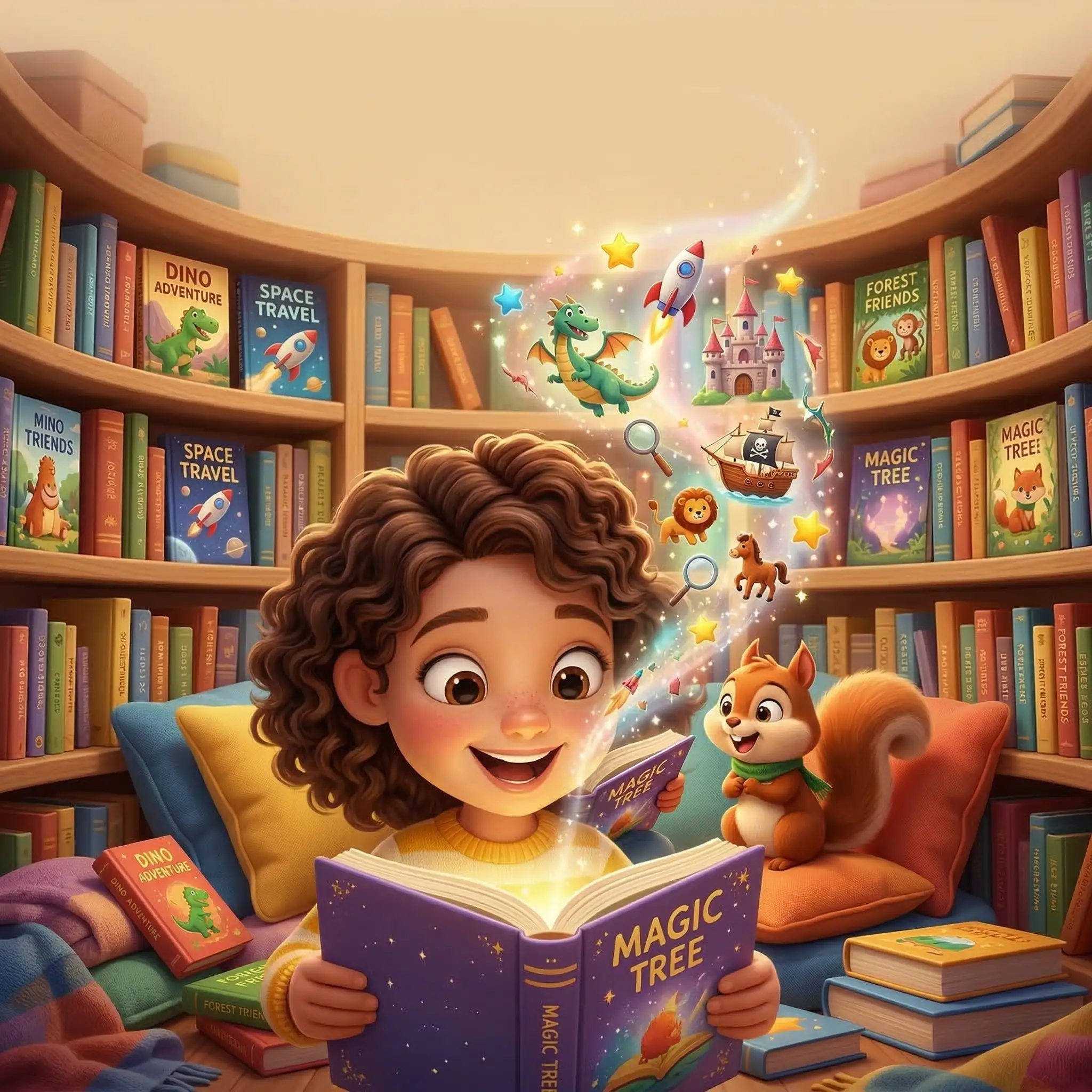
Children who find books that match their interests naturally develop a love for reading. Children who repeatedly encounter books that feel boring or difficult may begin to believe that reading simply isn’t enjoyable.
Research in reading motivation shows that interest is one of the strongest predictors of whether children continue reading regularly (Guthrie & Wigfield, 2000).
In other words, when children discover books they genuinely enjoy, reading stops feeling like a chore and becomes something they look forward to.
The challenge for many parents is helping children find those books.
Fortunately, there are several simple strategies that make book discovery much easier.
Step 1: Understand Your Child’s Interests
The easiest way to find books children enjoy is to start with their existing interests.
Children are naturally curious about topics they already care about.
For example:
A child who loves animals may enjoy wildlife stories.
A child fascinated by space might enjoy science fiction.
A child who enjoys solving puzzles might love mysteries.
Research suggests that connecting reading material to a child’s personal interests significantly increases engagement and persistence (Hidi & Renninger, 2006).
Parents can begin by observing everyday conversations.
Ask simple questions such as:
What kind of stories do you enjoy?
Do you like funny stories or exciting adventures?
Would you rather read about real people or imaginary worlds?
These questions help identify the themes that naturally excite the child.
Step 2: Introduce Different Genres
Sometimes children believe they dislike reading simply because they have only experienced one type of book.
Introducing different genres can reveal unexpected interests.
Some popular genres for children include:
fantasy
mystery
adventure
science fiction
humor
biographies
Each genre offers a different kind of experience.
Fantasy stimulates imagination, mysteries challenge analytical thinking, and adventure stories inspire curiosity.
By exploring multiple genres, children are more likely to discover stories that resonate with them.
Step 3: Let Children Choose Their Own Books
Many parents carefully select books they believe children should read.
While this intention is understandable, excessive control over book choices can reduce motivation.
Studies show that children are more motivated to read when they feel ownership over their choices (Guthrie & Wigfield, 2000).
Allowing children to choose books gives them a sense of independence.
Even if the book seems simple or silly, enthusiasm matters more than difficulty.
When children enjoy reading, they naturally begin exploring more complex books later.
Step 4: Visit Libraries and Bookstores Together
Book discovery is often an exciting experience in itself.
Libraries and bookstores allow children to:
browse shelves
flip through pages
read book covers
explore different sections
Research shows that access to diverse reading materials significantly increases reading engagement (Krashen, 2004).
Parents do not need to direct children toward specific titles immediately.
Sometimes simply walking through shelves and discovering interesting covers can spark curiosity.
The goal is to make book discovery feel like exploration rather than assignment.
Step 5: Pay Attention to Book Difficulty
One reason children lose interest in reading is that books may feel too difficult.
If reading requires constant effort, enjoyment disappears quickly.
Literacy experts often recommend the “five-finger rule.”
If a child encounters more than five unfamiliar words on a single page, the book may be too challenging for independent reading.
Choosing books slightly below a child’s reading level can help build confidence and fluency.
Confidence plays a major role in sustaining reading motivation.
Step 6: Encourage Conversations About Books
Discussing stories helps children reflect on what they read.
Parents can ask questions such as:
Which character did you like the most?
What surprised you in the story?
What do you think might happen next?
Research suggests that story discussions improve comprehension and deepen engagement (Whitehurst & Lonigan, 1998).
These conversations also help parents understand what kinds of stories children enjoy most.
Over time, this insight helps guide future book recommendations.
Step 7: Allow Children to Abandon Books
Adults often feel guilty leaving a book unfinished.
Children sometimes feel the same pressure.
However, forcing a child to finish a book they dislike can damage reading motivation.
Allowing children to move on from a book that doesn’t interest them encourages exploration.
Not every book will be the right fit.
Discovering the books they truly enjoy sometimes requires trying several options first.
Step 8: Use Series to Build Momentum
Book series can be extremely helpful for developing reading habits.
When children enjoy the first book in a series, they naturally become curious about what happens next.
This anticipation encourages continued reading.
Many popular children’s books are written as series because recurring characters and ongoing storylines keep readers engaged.
Series also reduce the effort of discovering new books since children already know they enjoy the world and characters.
Step 9: Combine Reading With Creativity
Stories often inspire children to create their own ideas.
Parents can encourage activities such as:
drawing favorite scenes
inventing alternate endings
imagining new adventures for characters
writing short stories
Research suggests that storytelling activities strengthen language development and creative thinking (Bruner, 1990).
These creative connections deepen a child’s relationship with books.
Signs Your Child Has Found the Right Books
Parents can often recognize when a child has discovered books they truly enjoy.
Signs include:
reading voluntarily without reminders
asking for the next book in a series
discussing characters enthusiastically
staying up late to finish a story
recommending books to friends
These behaviors indicate that reading has shifted from obligation to genuine curiosity.
The Long-Term Impact of Book Discovery
When children discover books they love, reading often becomes a lifelong habit.
Research shows that children who read for pleasure tend to develop:
stronger vocabulary
improved academic performance
greater empathy
stronger imagination
A long-term study from the University of Oxford found that reading for pleasure in childhood strongly predicts later educational success (Sullivan & Brown, 2013).
But perhaps the greatest benefit is simpler.
Books become companions that children return to throughout their lives.
Final Thoughts
Helping children discover books they love is one of the most powerful ways to nurture a lifelong reading habit.
The process does not require complicated strategies.
It begins with simple steps:
understanding a child’s interests
exploring different genres
allowing freedom of choice
creating opportunities for discovery
Once a child finds the stories that excite their imagination, reading no longer needs encouragement.
Curiosity takes over.
And that curiosity can open the door to a lifetime of learning and imagination.