How Stories Help Children Develop Empathy
Stories help children practice perspective-taking and emotional understanding. Learn how reading fiction supports empathy, kindness, and social skills.
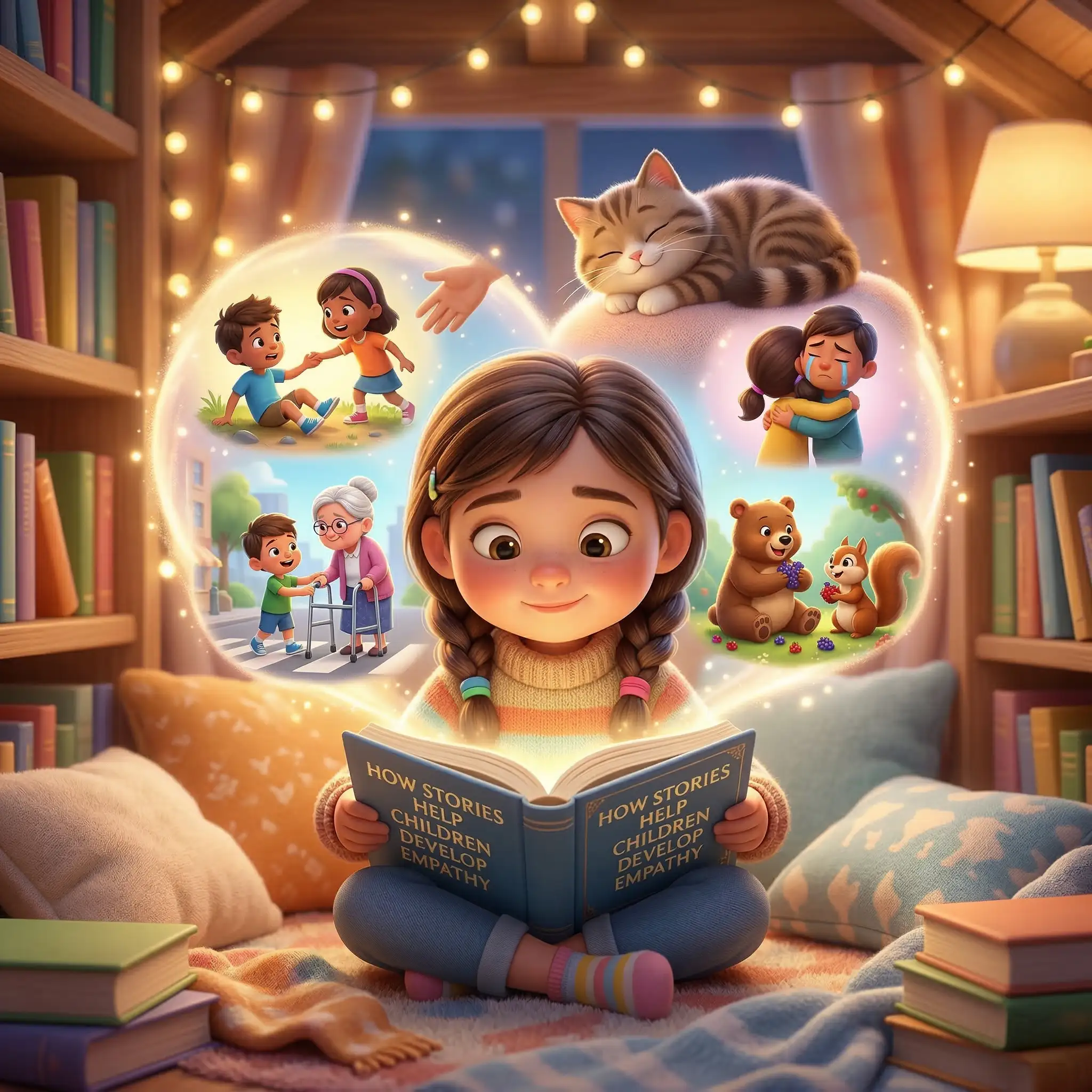
Why Empathy Is One of the Most Important Skills Children Can Learn
Parents often focus on helping children develop skills like reading, mathematics, and problem-solving.
But there is another ability that plays a crucial role in a child’s long-term success and relationships:
Empathy.
Empathy is the ability to understand and share the feelings of others.
Children who develop empathy are more likely to:
build stronger friendships
resolve conflicts peacefully
understand different perspectives
respond kindly to others’ emotions
Research in developmental psychology shows that empathy is strongly connected to emotional intelligence and social well-being (Eisenberg, Spinrad & Sadovsky, 2006).
While empathy develops naturally through social experiences, stories and books can play a powerful role in nurturing this ability.
Reading allows children to step inside the minds of characters and experience situations from perspectives different from their own.
Why Stories Are Powerful Tools for Emotional Learning
Stories allow children to observe and experience emotions in a safe environment.
Through narratives, children encounter characters facing a wide range of feelings such as:
happiness
sadness
fear
courage
jealousy
kindness
As children follow these emotional journeys, they begin to understand how actions affect others.
Research shows that reading fiction improves social cognition, the ability to understand people’s thoughts and feelings (Mar, Oatley & Peterson, 2009).
In other words, stories help children practice understanding emotions before they encounter similar situations in real life.
How Reading Helps Children See the World Through Different Eyes
Empathy often develops when children realize that others may think and feel differently from them.
Stories create opportunities for children to explore perspectives beyond their own experiences.
For example, a story might involve:
a child moving to a new school
a character feeling lonely
someone overcoming fear
a friend facing a difficult challenge
While reading, children imagine how these characters feel and why they behave in certain ways.
Psychologists call this process perspective-taking.
Perspective-taking is one of the core components of empathy.
Research suggests that narrative fiction improves this ability by encouraging readers to mentally simulate the experiences of others (Mar & Oatley, 2008).
Emotional Understanding Through Characters
Stories often explore emotional situations that children may not yet encounter in everyday life.
Through books, children might witness:
a character standing up for a friend
someone apologizing after making a mistake
a character overcoming personal struggles
friendships forming despite differences
These experiences allow children to reflect on emotional situations without the pressure of real-life consequences.
This reflective process helps children recognize emotions more clearly.
Studies suggest that children who read stories frequently develop stronger emotional vocabulary, which helps them describe and understand feelings (Nikolajeva, 2014).
How Stories Teach Kindness and Compassion
Empathy is closely connected to compassion — the desire to help others who are suffering.
When children become emotionally invested in a story, they often feel concern for the characters.
They may hope the hero succeeds or feel sadness when a character struggles.
These emotional reactions strengthen children’s ability to care about others.
Research suggests that reading fiction increases prosocial behavior, such as helping and cooperating with others (Johnson, 2012).
Stories provide examples of kindness and generosity that children may later imitate in real life.
Why Diverse Stories Matter
Stories from different cultures and perspectives help children develop a broader understanding of the world.
Books can introduce children to experiences such as:
life in different countries
diverse family structures
historical challenges
unique cultural traditions
Exposure to diverse perspectives encourages children to appreciate differences and respect others.
Research suggests that reading culturally diverse literature helps reduce stereotypes and increases cross-cultural empathy (Vezzali et al., 2015).
Through stories, children learn that people from different backgrounds share many common emotions and experiences.
The Role of Discussion in Building Empathy
Reading becomes even more powerful when children talk about stories.
Discussing characters’ feelings encourages children to reflect more deeply on emotional situations.
Parents can ask questions such as:
Why do you think that character felt sad?
What would you have done in that situation?
How do you think the other characters felt?
These conversations encourage children to think about emotions and relationships.
Research suggests that discussing stories improves children’s emotional awareness and social understanding (Whitehurst & Lonigan, 1998).
How Empathy Supports Children’s Development
Empathy contributes to many important aspects of a child’s development.
Children with strong empathy skills often demonstrate:
better friendships
stronger communication skills
improved conflict resolution
greater emotional awareness
Empathy also plays a role in leadership and collaboration later in life.
Understanding others’ perspectives helps individuals work effectively in teams and navigate complex social environments.
Stories help lay the foundation for these abilities.
Encouraging Empathy Through Reading
Parents can support empathy development by choosing books that explore emotions and relationships.
Stories that focus on:
friendships
challenges
moral choices
kindness and fairness
can spark meaningful conversations.
Encouraging children to reflect on characters’ experiences helps them connect those lessons to their own lives.
Reading and Emotional Intelligence
Emotional intelligence involves recognizing emotions, understanding others’ feelings, and responding appropriately.
Books help develop these abilities by exposing children to complex emotional situations.
Research suggests that children who frequently read narrative fiction show improved theory of mind, the ability to understand other people’s thoughts and intentions (Kidd & Castano, 2013).
This skill is essential for empathy, communication, and social awareness.
Final Thoughts
Stories are far more than entertainment.
They are powerful tools for helping children understand emotions, relationships, and human experiences.
Through books, children learn to step into the lives of others, feel compassion for characters, and reflect on their own behavior.
These experiences nurture empathy — one of the most valuable qualities a child can develop.
When children read stories, they are not only exploring imaginary worlds.
They are learning how to understand the people around them.