How to Choose the Right Books for Your Child’s Personality
Match books to your child’s personality—curious, sensitive, adventurous, analytical, or imaginative—so reading feels like self-expression, not homework.
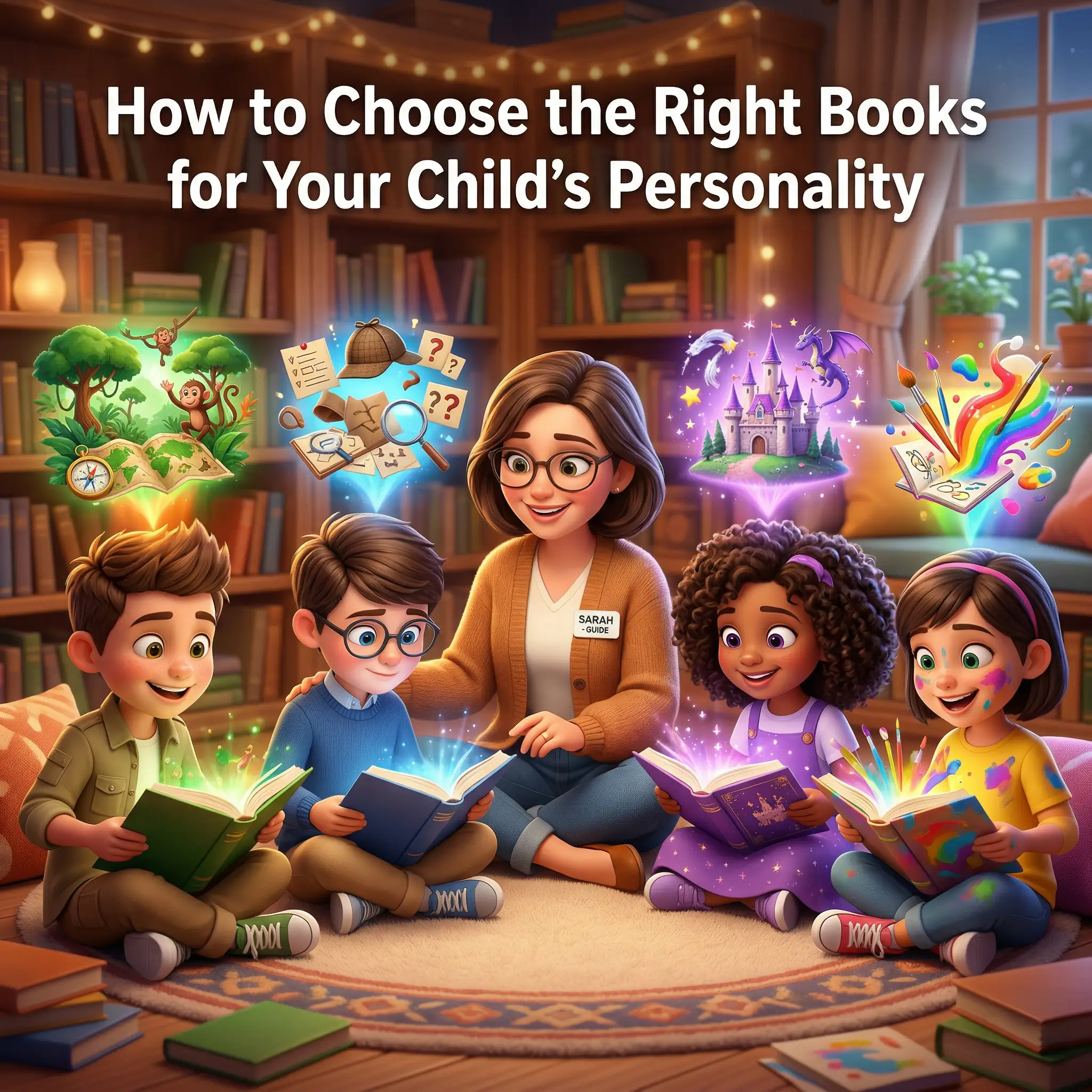
How to Choose the Right Books for Your Child’s Personality
Most parents don’t struggle to find books. They struggle to find the right book.
You buy a highly recommended title. Your child reads two pages… and loses interest.
You try again. Same result.
At some point, it starts to feel like: “Maybe my child just doesn’t like reading.”
But here’s the truth:
Children don’t dislike reading. They dislike books that don’t match who they are.
And once you understand your child’s personality, reading stops feeling like a task—and starts becoming something they naturally enjoy.
Why Personality Matters More Than Reading Level
Most book recommendations are based on:
Age
Reading level
School curriculum
But these miss the most important factor: intrinsic motivation.
According to Guthrie & Wigfield (2000), children read more when they feel personally connected to what they are reading. Interest—not ability—is the strongest predictor of reading engagement.
That means:
A “perfect level” book can still fail
A slightly difficult book can succeed (if it excites them)
👉 The question is not: “Can my child read this?” 👉 It’s: “Does my child want to read this?”
Step 1: Understand Your Child’s Core Personality Type
You don’t need complicated frameworks. Just observe how your child naturally behaves.
Here are the most common personality patterns in children:
1. The Curious Explorer
Traits:
Asks endless “why” questions
Loves facts, discovery, and learning how things work
Enjoys documentaries, science kits, experiments
What works:
Non-fiction
Science and space books
“How things work” books
Biographies of inventors and explorers
What fails:
Slow fictional stories without clear purpose
2. The Imaginative Dreamer
Traits:
Loves stories, fantasy, and pretend play
Enjoys cartoons, fictional worlds, and storytelling
Often lost in imagination
What works:
Fantasy novels
Magical worlds
Adventure stories
Mythology
What fails:
Dry factual books
3. The Action Seeker
Traits:
High energy
Gets bored quickly
Loves fast-paced games and movement
What works:
Short chapters
Action-packed plots
Graphic novels
Mystery and thrillers
What fails:
Slow, descriptive writing
4. The Emotional Connector
Traits:
Sensitive and empathetic
Connects deeply with characters
Enjoys relationships and emotional stories
What works:
Character-driven stories
Friendship and family themes
Real-life situations
What fails:
Purely plot-driven books without emotion
5. The Logical Thinker
Traits:
Loves patterns, puzzles, and problem-solving
Enjoys strategy games
Thinks analytically
What works:
Mystery books
Puzzle-based stories
Detective fiction
What fails:
Abstract or overly emotional storytelling
Important Insight
Most children are not just one type.
They are usually a blend.
But even identifying the dominant tendency changes everything.
Step 2: Match Book Style, Not Just Topic
Parents often choose books based on topic.
But children respond more to experience.
For example:
Two books about space:
One is slow and descriptive
One is filled with exciting discoveries and visuals
A curious child will love both. An action seeker will only like the second.
👉 So instead of asking: “Is this about dinosaurs?”
Ask: “How does this book feel to read?”
Step 3: Watch Your Child’s Natural Content Choices
Your child is already telling you what they like.
Just not through books.
Observe:
What YouTube videos do they watch?
What games do they enjoy?
What stories do they repeat?
These patterns reveal content preferences.
According to Krashen (2004), voluntary reading increases significantly when children are exposed to content aligned with their interests—even outside traditional reading environments.
Step 4: Use the “First 10-Minute Rule”
A simple test:
Give your child a book.
Watch for 10 minutes.
Signs it’s the right book:
They forget to check time
They ask questions
They react emotionally
Signs it’s wrong:
Fidgeting
Looking around
Closing the book quickly
This is more reliable than reviews or ratings.
Step 5: Stop Forcing “Good Books”
Many parents unintentionally make this mistake:
Choosing award-winning books
Prioritizing “educational value”
Ignoring enjoyment
But forcing the “right” books often leads to:
Resistance
Boredom
Negative association with reading
Research from Deci & Ryan (1985) on self-determination theory shows that autonomy (choice) is critical for intrinsic motivation.
👉 When children feel forced, they disengage. 👉 When they feel ownership, they explore.
Step 6: Build a Reading Journey (Not Just One Book)
Reading is not about one perfect book.
It’s about a sequence of experiences.
Start with:
Easy + engaging books
Then move to:
Slightly challenging + interesting
This gradual progression builds:
Confidence
Attention span
Deeper thinking
Why Many Parents Still Struggle (Even After Trying Everything)
Even when parents follow all steps, they face one challenge:
They don’t know how to guide the experience.
Because reading is not just:
Picking a book
Asking the child to read
It’s about:
Asking the right questions
Creating curiosity
Building emotional connection
This is where most children lose interest.
The Missing Piece: Guided Reading
Children don’t become readers just by having books.
They become readers through experiences around books.
For example:
Discussing characters
Predicting what happens next
Connecting stories to real life
This transforms reading from:
👉 “activity” → into → “engagement”
How Bookstaken Solves This (Without Feeling Like Study)
At Bookstaken, the goal is not to make children read more.
It’s to help them want to read more.
Here’s how it naturally fits into a child’s personality:
A curious child explores ideas through discussion
An imaginative child dives deeper into stories
An action-oriented child stays engaged through interactive sessions
Each child is matched with a mentor who:
Understands their personality
Chooses the right type of books
Turns reading into a conversation
So instead of:
👉 “Finish this book”
It becomes:
👉 “Let’s explore this story together”
And that changes everything.
Practical Checklist for Parents
Before choosing a book, ask:
Does this match my child’s personality?
Will this feel engaging in the first 10 minutes?
Is this aligned with what they already enjoy?
Am I choosing this for them or for my expectations?
Internal Linking Suggestions
Complete Parent’s Guide to Raising a Reader
How to Make Reading a Daily Habit (Without Resistance)
Why Your Child Doesn’t Like Reading (It’s Not What You Think)
How to Help Your Child Sit and Focus Without Forcing Them
Final Thought
Choosing the right book is not about finding the best book.
It’s about finding the right book for your child.
Because when the match is right:
Reading becomes easier
Attention improves naturally
Curiosity grows on its own
And most importantly—
Your child stops seeing reading as something they have to do and starts seeing it as something they want to do.
If you get this one decision right, you don’t just improve reading…
You shape how your child learns for life.
Responses
Latest Articles
Similar Articles
Want Your Child to Experience Books More Deeply?
Bookstaken pairs kids with caring mentors who turn reading into engaging conversations, inspiring them to eventually write their own stories.