Why Your Child Doesn’t Like Reading (It’s Not What You Think)
Most kids don’t dislike reading—they dislike the friction around it. Learn the real reasons and practical ways to rebuild interest without pressure.
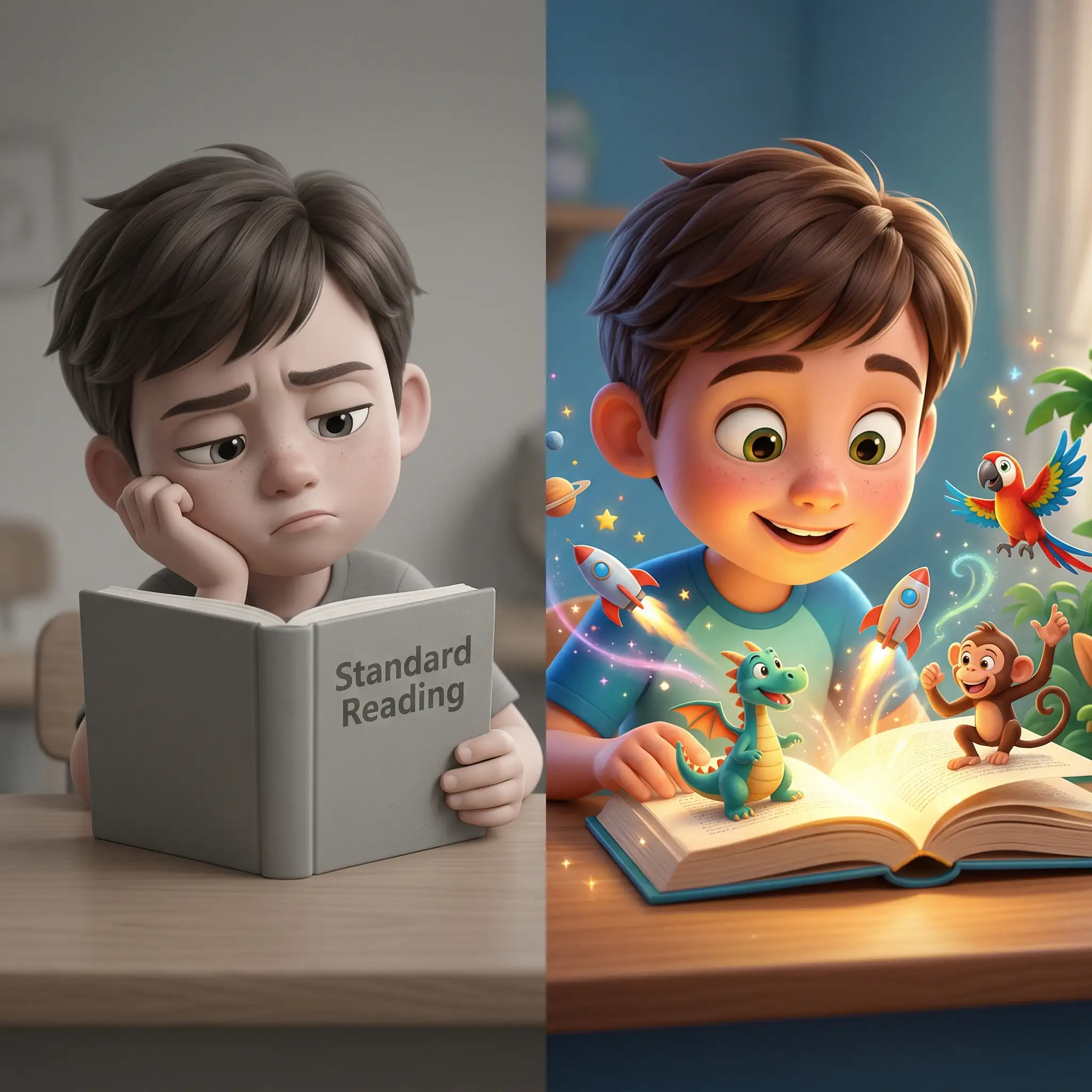
The Common Assumption Parents Make
When a child avoids reading, most parents think:
“My child is lazy.”
“They just don’t like books.”
“They prefer screens too much.”
But here’s the truth:
Most children don’t hate reading. They hate the experience they’ve had with reading.
A child is not born disliking stories.
In fact, most young children love stories — they enjoy listening, imagining, and asking questions.
So what changes?
Why do some children suddenly start avoiding books?
Understanding the real reasons is the first step to fixing it.
Reason 1: Reading Feels Like Work, Not Enjoyment
One of the biggest reasons children lose interest in reading is that it becomes associated with school pressure.
Reading starts to mean:
assignments
tests
comprehension questions
“finish this chapter”
Research shows that when an activity is associated with external pressure, intrinsic motivation decreases (Ryan & Deci, 2000).
Instead of curiosity, children feel obligation.
And anything that feels like work is naturally avoided.
What parents can do
Reintroduce reading as a relaxed, enjoyable activity.
remove pressure
avoid testing or quizzing
focus on story, not performance
Reason 2: The Child Hasn’t Found the Right Book
This is the most common — and most overlooked — reason.
Many children say they don’t like reading simply because:
👉 They haven’t found a book that excites them.
Research shows that interest is the strongest predictor of reading engagement (Guthrie & Wigfield, 2000).
A child who finds the right book can go from:
“I hate reading” → “I can’t stop reading”
What parents can do
Focus on discovery:
try different genres
allow freedom of choice
experiment without pressure
Reason 3: Books Feel Too Difficult
If reading feels like a struggle, children quickly lose motivation.
They may experience:
difficulty understanding words
slow reading speed
frustration
lack of confidence
Research shows that low reading confidence leads to avoidance behavior (Snow, Burns & Griffin, 1998).
Children don’t avoid reading because they’re lazy.
They avoid it because it feels uncomfortable.
What parents can do
choose slightly easier books
allow re-reading familiar stories
build confidence first
Confidence → enjoyment → habit
Reason 4: Screens Provide Instant Reward
Screens are designed to be addictive.
They offer:
fast-paced visuals
instant gratification
continuous stimulation
Compared to this, books require:
patience
imagination
focus
Research suggests that excessive screen exposure may reduce attention span and reading interest (Twenge et al., 2018).
This creates a natural imbalance.
What parents can do
Don’t remove screens completely.
Instead:
create balanced routines
introduce reading before screen time
make reading engaging, not forced
Reason 5: Reading Feels Lonely
Many children struggle with reading because it is a solo activity.
Unlike games or videos, books don’t provide interaction.
But research shows that social interaction improves engagement and learning (Vygotsky, 1978).
Children enjoy activities more when they feel connected.
What parents can do
Make reading interactive:
read together
discuss stories
ask fun questions
act out characters
This transforms reading into a shared experience.
Reason 6: Too Many “Rules” Around Reading
Some children experience reading as a strict activity with rules like:
read for X minutes
don’t skip pages
finish the book
read “proper” books
While structure is useful, too many rules can reduce enjoyment.
Children begin to feel controlled rather than curious.
What parents can do
Relax the rules:
allow book-switching
allow different formats (comics, illustrated books)
focus on engagement over discipline
Reason 7: Lack of Consistency
Reading is a habit.
And habits require consistency.
Many children:
read occasionally
skip long periods
restart repeatedly
Research on habit formation shows that consistent repetition is key to building automatic behavior (Lally et al., 2010).
Without consistency, reading never becomes natural.
What parents can do
Create a simple routine:
15–20 minutes daily
same time each day
low pressure
Reason 8: No Emotional Connection to Stories
Children engage deeply when they feel connected to characters or situations.
If a book doesn’t create that connection, it feels boring.
Stories that resonate emotionally are far more engaging.
Research shows that emotional engagement improves memory, comprehension, and motivation (Mar et al., 2006).
What parents can do
Choose books with:
relatable characters
exciting plots
emotional depth
And most importantly — talk about them.
Signs Your Child Doesn’t Hate Reading (Just the Current Experience)
Many parents misinterpret behavior.
Your child may still have reading potential if they:
enjoy listening to stories
like movies with strong narratives
ask imaginative questions
show curiosity
These are all signs of latent reading interest.
It just needs the right environment.
The Real Shift Parents Need to Make
Instead of asking:
❌ “How do I make my child read?”
Ask:
✅ “How do I make reading enjoyable for my child?”
This shift changes everything.
Why This Matters Long-Term
Children who develop a positive relationship with reading gain:
stronger thinking skills
better academic performance
improved focus
higher creativity
A long-term study found that reading for pleasure is strongly linked to cognitive development and educational success (Sullivan & Brown, 2013).
But beyond academics, reading builds something deeper:
👉 curiosity
Where Most Parents Get Stuck
Even when parents understand all this, they struggle with:
finding the right books
maintaining consistency
engaging their child regularly
Because it requires time, effort, and constant involvement.
Final Thoughts
Your child doesn’t dislike reading.
They dislike:
boring books
pressure
frustration
isolation
Once these barriers are removed, reading becomes:
engaging
enjoyable
natural
The goal is not to force reading.
The goal is to create an environment where reading becomes something the child wants to do.
And when that happens, the habit builds itself.