Bookstaken pairs kids with caring mentors who turn reading into engaging conversations, inspiring them to eventually write their own stories.
Responses
No responses yet. Be the first to share your thoughts.
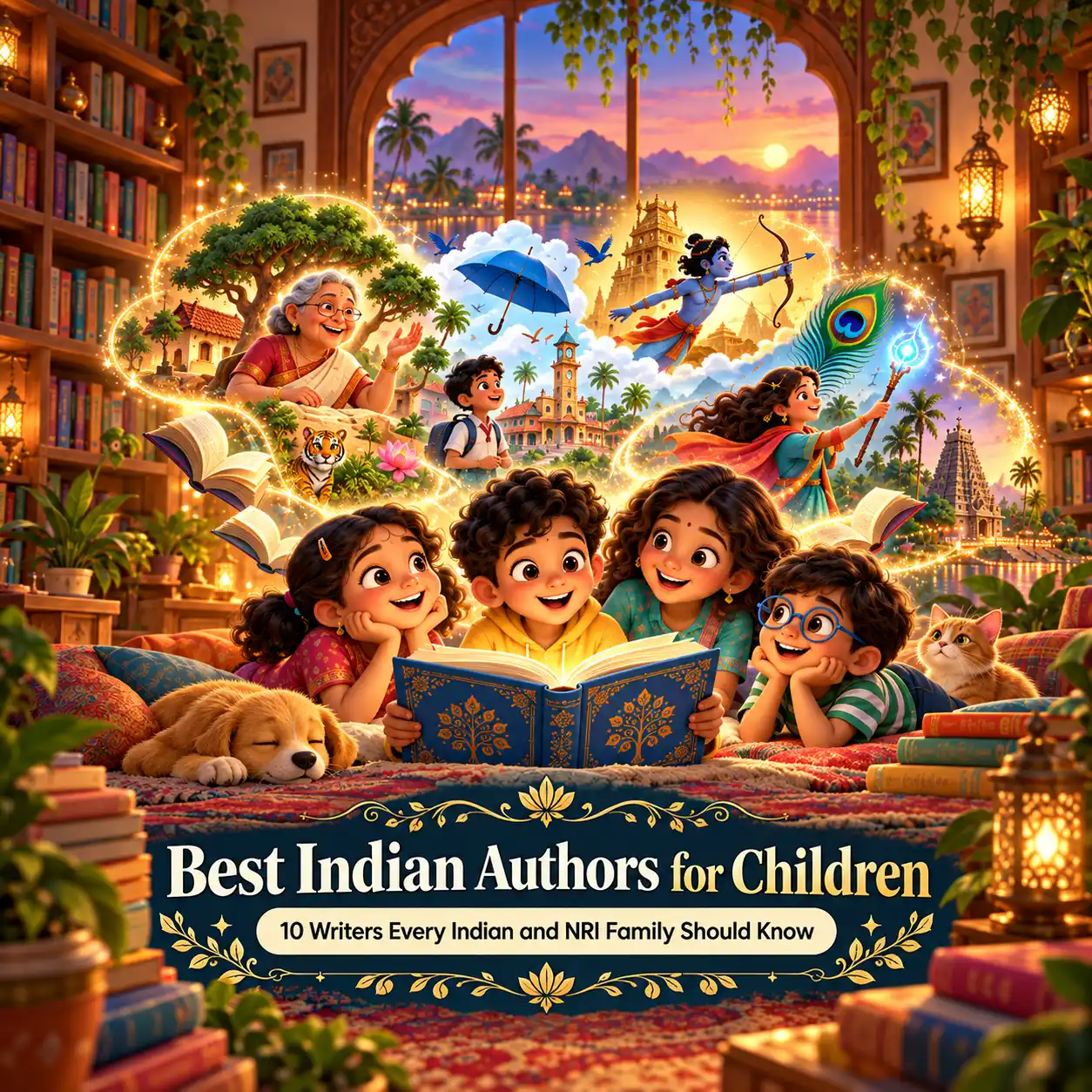
The best Indian authors for children include Sudha Murty, Ruskin Bond, R. K. Narayan, Anant Pai (Amar Chitra Katha), Roopa Pai, Anushka Ravishankar, Bhakti Mathur, Chitra Soundar, Roshani Chokshi and Subhadra Sen Gupta. Between them they cover every age from 6 to 14, and every kind of reader: funny, curious, sensitive, adventurous.
Most of the books our children read are written far from India. That is not a problem in itself; great stories travel. But children also need books where the grandmother, the food, the festival and the classroom look like theirs. For NRI families it matters even more: an Indian story is sometimes the only place a child meets their culture on an ordinary Tuesday.
Here are ten writers we reach for again and again at Bookstaken, with the book to start with for each.
Sudha Murty writes the way a favourite aunt tells stories after dinner: simple, warm and always with something to think about. Her books are short enough for a new reader to finish, which is exactly what builds a reading habit. If you only buy one Indian author, make it her.
Bond's hill stations, rivers and small towns are slow and gentle, but children who give them a chance find themselves inside the story. The Blue Umbrella is short, funny and quietly moving, a good test of whether your child is ready for him.
Swami skips homework, dreads his teachers and gets into scrapes with his friends. Written almost a century ago, it still feels like any Indian school today, which is why children laugh at it. It is also a lovely book to read together; parents often remember it from their own childhood.
4. Anant Pai and Amar Chitra Katha
Start with: a single hero your child already knows, like Hanuman or Krishna (ages 6–12), then Ashoka the Great or Akbar (7–13).
Anant Pai founded Amar Chitra Katha in 1967, and its comics have introduced generations of children to the Ramayana, the Mahabharata and Indian history. Comics are real reading (we explain why in Should Kids Read Comics or "Real" Books?), and for many reluctant readers this is the way in.
Roopa Pai makes big ideas conversational. Her Gita reads like a clever older cousin explaining things, with questions and jokes along the way, not a sermon. It suits curious children who ask "but why?" about everything.
A boy, a monster that appears in his room and a lot of chaos. Ravishankar is one of India's funniest children's writers, and her books are proof that Indian stories do not have to be about lessons or mythology to be Indian.
The Amma, Tell Me series explains festivals and mythology in rhyming picture books: Diwali, Holi, Durga Puja, Raksha Bandhan, Krishna, Ganesha and more. They are a favourite with NRI families because they answer the questions children ask when a festival arrives far from home.
Gentle, funny picture books set in rural India, perfect for younger siblings and for reading aloud. Short enough for a bedtime, rich enough to talk about afterwards.
9. Roshani Chokshi
Start with:Aru Shah and the End of Time (ages 9–14).
An Indian-American girl accidentally frees an ancient demon and discovers she is a reincarnated Pandava. Think Percy Jackson, but with Hindu mythology. For children who love fantasy series, and especially for NRI children, Aru Shah is often the book that makes mythology feel like theirs.
10. Subhadra Sen Gupta
Start with:Kings and Queens (ages 8–12). Then:A Children's History of India (12–14).
History told as stories about real people, with the gossip and adventure left in. A great choice for the child who prefers facts to fiction.
More Indian writers to explore
Mahasweta Devi, The Why-Why Girl (ages 4–9): a curious girl who never stops asking questions.
Anita Desai, The Village by the Sea (9–13): a brother and sister holding their family together.
Devdutt Pattanaik, Pashu: Animal Tales from Hindu Mythology (9–11).
Rohini Chowdhury's retelling of the Panchatantra (6–12), the classic animal fables in a readable modern edition.
How to choose the right one for your child
Match the author to the child, not the other way round. A child who loves jokes will enjoy Anushka Ravishankar long before R. K. Narayan. A child who loves fantasy should meet Roshani Chokshi first. A child who asks questions all day will enjoy Roopa Pai.
Not sure where your child fits? Our free book recommendation quiz asks about their age, interests and reading habits and picks seven books matched to them, including Indian authors if you want them.
Questions parents ask
Who is the best Indian author for young children?
For ages 6–10, Sudha Murty is the easiest place to start: short, warm stories that new readers can finish on their own. For picture-book ages, Bhakti Mathur and Chitra Soundar are wonderful read-alouds.
Which Indian books are good for NRI children?
Books that connect everyday life to India work best: Sudha Murty's family stories, Bhakti Mathur's festival books, Amar Chitra Katha comics and Roshani Chokshi's Aru Shah series. We share more ideas in Raising a Reader in an NRI Family.
Are Indian authors available outside India?
Most of the books above are published by Puffin/Penguin India, Scholastic India or international publishers, and are available on Amazon in most countries and as e-books.