Why Forcing Kids to Read Backfires (And What to Do Instead)
Forcing reading can harm motivation. Learn what to do instead: autonomy, better book fit, small routines, and making reading feel safe again.
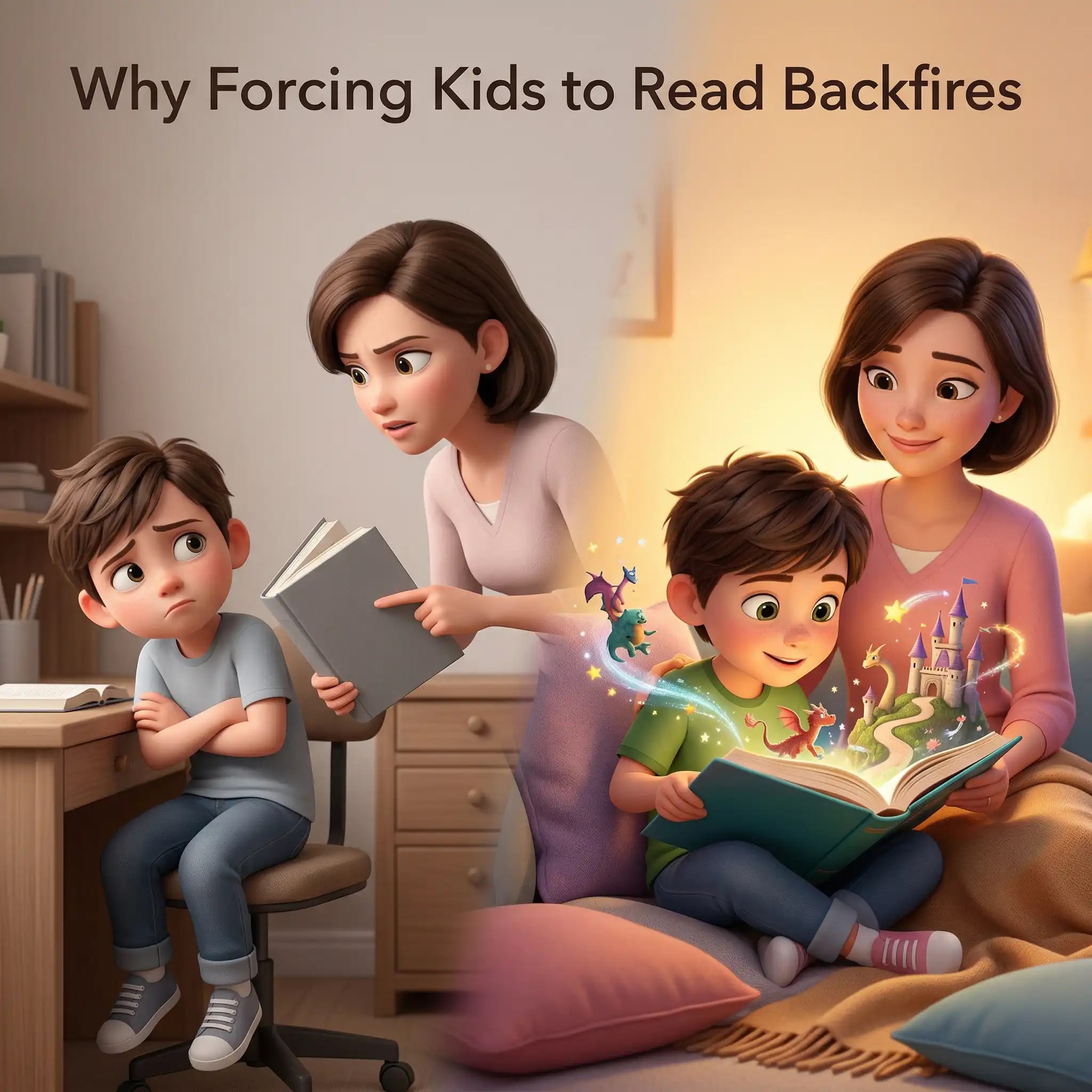
Why Forcing Kids to Read Backfires
"You are not playing any video games until you read for twenty minutes."
It sounds like a perfectly reasonable parenting boundary. You want your child to succeed, you know reading is critical for their brain development, and sometimes they just need a little push, right?
But then the timer starts. Your child stares blankly at the page. They sigh heavily. They complain that the book is boring, their eyes hurt, or they are suddenly starving. By the time the twenty minutes are up, you are exhausted, they are miserable, and absolutely zero actual learning has taken place.
If this sounds familiar, you are not alone. As parents, our instinct is to enforce rules when we see our kids avoiding something important. But when it comes to reading, forcing compliance is the fastest way to kill a child’s love for books. Here is the science behind why forced reading backfires, and how to pivot to a strategy that actually works.
The Psychology of the "Affective Filter"
To understand why forcing fails, we have to look at what happens in a child's brain when they feel pressured.
In educational psychology, there is a concept called the Affective Filter. Think of it as an invisible brick wall in the brain that goes up when a child feels stressed, anxious, or forced. When you issue a reading ultimatum, you trigger a mild "fight or flight" response. Cortisol (the stress hormone) floods their system, and their affective filter shoots up.
Once that wall is up, the prefrontal cortex—the part of the brain responsible for decoding words, focusing, and comprehending a story—effectively shuts down. You cannot force a stressed brain to learn. They might physically stare at the words until the timer dings, but they are not absorbing the story.
The Death of Intrinsic Motivation
There are two types of motivation: extrinsic (doing something for a reward or to avoid punishment) and intrinsic (doing something because you genuinely enjoy it).
Reading requires heavy cognitive lifting. To sustain that kind of effort over a lifetime, a child must have intrinsic motivation.
When you force a child to read, or bribe them with screen time, you are sending a very clear subconscious message: Reading is a miserable chore that must be endured in order to get to the good stuff. You accidentally teach them that the book is the punishment and the iPad is the prize. Over time, their intrinsic motivation to pick up a book drops to zero.
What to Do Instead: The Pressure-Free Approach
If you want to raise a child who genuinely loves to read, you have to take the pressure off and change the environment. Here is how to rebuild their motivation naturally.
1. Call a "Reading Ceasefire" If books have become a battleground, the very first step is to stop fighting. Take a week off from mandatory independent reading. Remove the timers, the logs, and the ultimatums. Give their brain a chance to lower its defenses and stop associating books with conflict.
2. Outsource to a 1-on-1 Reading Mentor Particularly for children in the 6-to-12-year-old range, the parent-child dynamic can carry too much emotional weight. Children want to please you, and when they struggle to read, they feel like they are failing you. This pressure causes them to push back.
Instead of acting as the homework police, connect them with a 1-on-1 reading mentor. Pairing a child with a bright, enthusiastic college student changes the entire paradigm. A mentor isn't an authority figure issuing commands; they are a cool, older peer. Through relaxed, conversational 1-on-1 sessions, a mentor can help a child tackle tough vocabulary and discover amazing stories without the emotional friction of a parent hovering over them. It turns reading into a highly engaging social connection.
3. Let Them Read "Junk Food" When we force kids to read, we often force them to read what we think is valuable (like award-winning historical fiction). If they hate the subject, they will hate the reading.
Hand the control over to them. If they only want to read graphic novels, comic books, video game manuals, or joke books, let them. Graphic novels are brilliant for reluctant readers because the illustrations provide a dopamine hit that keeps them turning pages while still requiring them to decode text.
4. Practice "Strewing" Instead of demanding they read, make reading irresistible and highly accessible. "Strew" visually appealing, high-interest books in places where they naturally get bored. Put a stack of comic books on the coffee table. Leave a magazine about their favorite sport on the kitchen island. Make the books easier to reach than the TV remote, and let their natural curiosity do the heavy lifting.
The Bottom Line
You cannot mandate a love for stories. Every time you remove the pressure, offer them a choice, or connect them with a mentor who makes reading fun, you are repairing their relationship with books.
It takes patience to step back and stop forcing the issue. But the moment reading becomes their choice, rather than your command, everything changes.
Share this post! Are you tired of the nightly homework battles? You are not alone! Share this article with a fellow parent who could use a guilt-free reason to throw away the reading timer today.
Responses
No responses yet. Be the first to share your thoughts.